 |
| @NIHR, apparently. Or possibly a forgotten Britpop band |
Showing posts with label UKRO. Show all posts
Showing posts with label UKRO. Show all posts
Monday, 15 January 2018
Dude, Who's Got My Twitter?


Thursday, 14 December 2017
Who Ya Gonna Call?
 |
| Downtown Brussels. Help is just a phonecall away (photo: Elliott Brown) |
Tuesday, 25 July 2017
Advice on Applying for an ERC Starting Grant
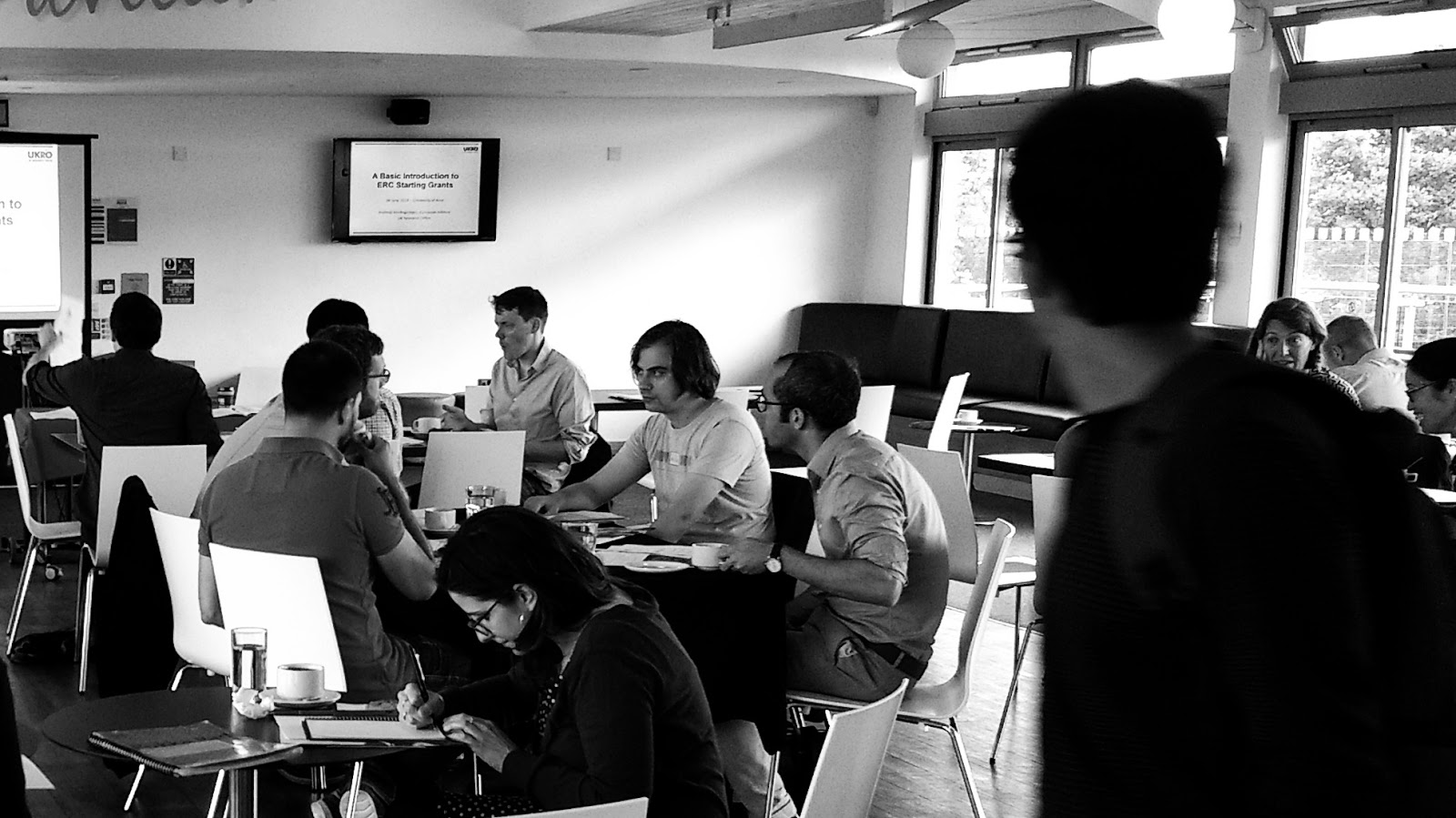 |
| The ERC Workshop last month |
The Project
Tracy is a paleoanthropologist, who looks at fossil remains to understand human evolution and development. Her €1.6m ERC-funded project, ‘GRASP’, examines two million year old hand bones to try and resolve two key questions in the field: did the earliest humans still use their hands to climb trees, and when did they start using tools.
The project uses innovative methods, including internal structural analysis using high-resolution microtomography (microCT).
Why Apply?
Tracy applied to the ERC in 2012, five years after getting her PhD. She was motivated to apply because her vision - and the research questions she was seeking to answer - required a large and complex project which was unlikely to be funded elsewhere.
Furthermore, the time was right for her. She had been at the Max Planck Institute, but neither her publication record nor her funding success were huge. However, she had had two high impact papers, including one as lead author that had made the cover of Science. In addition she was looking for a way to move back to the UK, as her partner was at UCL.
Writing the Application
‘Understanding the Participant Portal requires a degree in engineering’, Tracy joked, but her underlying point was well made: give yourself time to prepare and understand what’s required. But understanding the Portal was only the beginning, and Tracy mapped out a series of points to consider when preparing a bid.
Monday, 15 April 2013
European Grants Factory - 9 May

12:00 – 13:00 An Overview of Horizon 2020
Sobia Aslam (UKRO)
Rutherford Lecture Theatre 2
Sobia Aslam from the UK Research Office in Brussels (UKRO) will provide an overview of the EU’s new funding programme for research, Horizon 2020. It will succeed Framework Programme 7 (FP7) in January next year. It has a proposed €80 billion budget (a 46% increase over FP7), will bring together both research and innovation, and is intended to simplify the process of applying to the EC. Draft work programmes will start to emerge over the summer, so now is an excellent time to find out more about the new framework.
In addition, Sobia will be holding a surgery session after lunch to discuss individual applications, or focus on specific issues. So if you have questions about H2020, or perhaps have a Marie Curie application on the go, get in touch to book a slot.
13:00-13:30 – Lunch
13:30-15:00 – European Funding: is it for me?
Prof Simon Thompson (Computing) & Jenny Billings (CHSS)
Rutherford Lecture Theatre 2
This is a rerun of last year’s sell-out seminar that offers a warts and all view of the European funding. The EC is notorious for the complexity of its applications, but unlike the UK funding for research is ringfenced and growing. Jenny Billings (CHSS) and Simon Thompson (Computing), both veterans of EU funding, offer their insights into the highs and lows of applying for, managing and reviewing European applications.
The events are free, but do let me know if you are planning to come so that I can make sure there’s enough space and catering for all.
Tuesday, 4 September 2012
Mists, Mellow Fruitfulness & ERC Deadlines

- Firstly, try and get a look at previously successful applications. This is true for any funder, of course, but perhaps more so for the EU, as people are often confused by the specific language and structure that is expected. Seeing how someone else has done it really helps.
- Secondly, and following on from this, make sure you 'give them what they want'. Look at the criteria, and make sure you are meeting them. These grants are about you and your project: be clear why you are the right person with an exciting, ground breaking project at the 'frontier' of knowledge.
- In turn, leading on from this, the ERC are looking for something different. Perhaps more than any other funder, this is the chance to take risks, to do something challenging. So use your imagination and think big - but couch it in a robust managerial framework that will reassure those of a nervous disposition.
- Get feedback. Lots of feedback. Here at Kent we've got the Internal Peer Review system, so get in touch with us as early as possible. But get feedback elsewhere, too: your proposal needs to be easily understood and inspiring by people who might not know the field, and whose first language may not be English.
- Submit early and often. Each time you submit it overwrites your last version. Don't leave it until the last minute when there will be, inevitably, a software crash.
- If you're shortlisted for interview, prepare throughly. Set up a mock panel (we can help with this) and go through a dry run. Take on board the feedback. Go over to Brussels the day before the actual interview and scout out the terrain. You don't want to get lost and arrive breathless, confused and red faced, or get derailed by Eurostar holdups.
- At the interview, they will use reviewers' comments to question your proposal. You won't have seen these, but try and pre-empt them by thinking what elements of your project will be seized on.
- Finally, think of the poor panel. Not only will they have ploughed through hundreds of applications, but they then have to sit for days in a small, stuffy room watching anxious academics perform. Engage them, and be enthusiastic and confident.
Thanks to Jo Frost at UKRO for running these events, and to Dr Lawrence Moon of KCL for sharing his experiences of applying to the ERC.
The Consolidator Grants came later, on 21 Feb, so annoyingly don't fit neatly into my Keatsian reference. But we never let the truth get in the way of a glib opening sentence here at Fundermentals Towers.
Monday, 16 April 2012
Events of May
 It's like 1968 all over again. Sort of. Well, a lot of the events we've got planned may well mark 'the beginning of a prolonged struggle'. But be brave! Come along to one of the many events we've got planned, and we'll help you in the (funding) struggle. All are free, there are refreshments, and all staff are
welcome, but do let me know if you would like to attend any or all of them
so that I can get an idea of numbers.
It's like 1968 all over again. Sort of. Well, a lot of the events we've got planned may well mark 'the beginning of a prolonged struggle'. But be brave! Come along to one of the many events we've got planned, and we'll help you in the (funding) struggle. All are free, there are refreshments, and all staff are
welcome, but do let me know if you would like to attend any or all of them
so that I can get an idea of numbers.4 May: UKRO VISIT
- European Research Council Starting Grants (Keynes LT3, 12:30 -2pm) The next round of European Research Council Starting Grants is due to open in July, with deadlines early in the new year. These grants are very generous, offering those with 2-12 years postdoc experience up to €1.5m for 5 years. Competition is fierce, but success rates are on a par with those for Research Councils. Jo Frost, our Brussels’ UK Research Office (UKRO) rep, will provide an insight into these grants, and Funding Officers will be on hand to offer practical advice about
- Marie Curie Fellowships (Keynes LT3, 2pm – 3:30pm) Jo Frost will follow up her ERC talk by providing more information on the Marie Curie Fellowships. These are intended to encourage mobility for researchers within Europe. They can be on an individual basis, or as a network. The MC schemes are popular, and they have recently been revised by the EC. Jo will tell us more about these changes, and what the Commission has planned for the next Framework Programme.
9 May: EUROPE DAY
- PVC LUNCHTIME SEMINAR: ‘Europeanisation’ (Peter Brown Room, Darwin, 12:30-2pm) To mark Europe Day a special PVC’s Lunchtime Seminar will look at ‘Europeanisation.’ The Seminars offer a chance to find out about what research is happening across the University, and to meet others outside your School. The speakers are:
Simone
Glanert (Law): ‘How
‘Common' Is a Common Law Without a Common Language and a Common
Discourse: (Uncommon) Thoughts on the European Union’.
Ben Hutchinson
(SECL): ‘International Challenges for National Archives’.
Roger
Vickerman (Economics): ‘Economic integration through regional and
transport policies in Europe’.
Paolo
Dardanelli (Politics & IR): ‘European integration, party strategies, and state restructuring’.
- GRANTS FACTORY: ‘Eurovision: the Pros and Cons of European Funding’ (Peter Brown Room, Darwin, 2pm-3:30pm) This is a rerun of last year’s sell-out seminar that offers a warts and all view of the European funding. The EC is notorious for the complexity of its applications, but unlike the UK funding for research is ringfenced and growing. Jenny Billings (CHSS) and Simon Thompson (Computing), both veterans of EU funding, offer their insights into the highs and lows of applying for, managing and reviewing European applications. Places are limited, so book early.
10 May: UNDERSTANDING & APPLYING TO THE NATIONAL INSTITUTE OF HEALTH (NIHR) (Senate Building, 10am-4:30pm) Government funding for health-related research is distributed by the MRC and the NIHR. The MRC deals with basic research, the NIHR with research that will affect the NHS, including social care and public health research. Last year it gave out £210.5m of research grants through a range of programmes. This event will be a chance to understand how these differ and fit together. The programme will include talks by members of NIHR, as well as those who have had NIHR funding, and have helped with applications in the past. The full programme can be seen on the blog, here.
30 May: GRANTS FACTORY:
Writing Better Bids (Venue TBC, 10am-12pm) This perennial
favourite runs three times a year, and provides those attending with an
overview of what makes a good application, and how to draft your application so
that it is clear, readable and convincing. David
Shemmings provides insights based on the ’Grants Factory’ method developed
by Prof Andrew Derrington (formerly Dean of Social Sciences, now PVC at Liverpool)
and Jacqueline Aldridge. These are always well attended; book now if
you’re planning to draft a proposal.
Tuesday, 31 January 2012
Horizon 2020: Slides from UKRO Talk Available

Thanks to all those who were able to make it to the UKRO European Funding event on 20 January. The slides and the handout from the talk on Horizon 2020, together with the slides from the ERC workshop, are now available on the Research Services website, here (Kent login needed). If you have any questions about them, don’t hesitate to ask.
We are starting to take bookings for the next European funding event, due to take place on 9 May. This will focus on the pros and cons of European funding, led by two academics (Prof Simon Thompson (Computing) and Jenny Billings (CHSS)) who have considerable experience of both the highs and lows of engaging with the EC. Notes from last year’s event are available on the blog, here; if you’d like to take part in May do drop me a line.
Friday, 6 January 2012
Looking to the Horizon: UKRO Talk - 20 Jan

‘Looking to the Horizon: the end of FP7 and the future of European funding’
Jo Frost, European Advisor, UKRO
12:30-14:00, 20 January 2012
Venue TBC
Jo Frost is the University’s representative at UKRO. Based in Brussels, she is tapped into official and unofficial sources of information at the Commission, and has a comprehensive understanding of how EC funding works. She will be looking, in this talk, at the final two years of FP7, and what the EC is planning for the new framework programme, ‘Horizon 2020’. The EC published its proposals for this before Christmas, and this will be an opportunity to get an idea of what is planned. In addition, with Research Council funding becoming more and more difficult to access, and European funding increasing (and ringfenced) until the end of 2014, there are still plenty of opportunities to consider applying to FP7. Jo will talk a little about recent changes to the programme that you might not have seen.
The talk is open to all. Tea and coffee will be available. If you would like to come along, contact me.
Jo will also be taking part in a workshop for those currently working on ERC proposals. If you would like to take part in this, and I haven’t contacted you already, do let me know.
Finally, Jo will return in May to take part in a Grants Factory session with Simon Thompson and Jenny Billings on the pros and cons of European funding (see the notes from last year’s session, here). This will be aimed at those who are new to European funding. I’ll send out more detail of this in due course.
Tuesday, 20 December 2011
I Fought the Law, and the Law Published Proposals for Post-2014 Funding
 Now, as if all the excitement over the publication of the Horizon 2020 proposals wasn't enough, news is coming through that the European Commission is busily rearranging deckchairs elsewhere within its future funding provision. The Directorates General for Justice, Home Affairs and Employment, Social Affairs and Inclusion have got together to simplify the smorgasbord on offer. Less, in this case, may be more.
Currently DG Justice runs six - yes, six - programmes, covering various justice, rights and equality issues. These will be simplified to just two:
- Justice Programme, which aims to promote 'judicial co-operation in civil and criminal matters...where obstacles in cross-border judicial proceedings are eliminated.' The Programme will have €472m to play with, and hopes to tackle judicial cooperation, access to justice and reducing drug demand and supply.
- Rights & Citizenship Programme aims 'to contribute to the development of an area of freedom, security and justice, by promoting and supporting the effective implementation of a Europe of rights.' They have slightly less than Justice (€439m), and the hope is that this should be enough to do away with discrimination, basically.
- The Asylum and Migration Fund does what it says on the tin, and deals with issues of migration. Its overall budget will be around €3.9bn.
- The Internal Security Fund will support the EU approach to law enforcement co-operation, including the management of the EU's external borders. It's budget will be around €4.65bn.
- The Programme for Employment and Social Solidarity (PROGRESS), which will get €574m;
- The European Employment Services (EURES), which will get €143.7m, and
- The European Progress Microfinance Facility, which will get €191.6m.
Thursday, 1 December 2011
Horizon 2020 Proposal Published

Get ready with the party poppers. Cue the scratchy copy of 'Ode to Joy' on the turntable. Don the cardboard hats depicted the flags of all (EU) nations. For yesterday the EC officially published the proposal for Horizon 2020. Hurray!
This marks the formal beginning of the new Framework Programme, by which the European Commission will distribute its research funding. There's been plenty of rumour and discussion as it has developed so far, but the publication yesterday gives us the starting point for the EC's negotiations with the European Parliament and Council, before the proposals are adopted at the end of 2013, and H2020 begins in January 2014.
Better still, there's a page on which a new video will be added each day in the run up to the launch of Horizon 2020. That's 731 videos! I bet after the first 100 they'll be running short of ideas and taking the best viral hits from YouTube as their own. Watch out for an appearance by Benton/Fenton.
In summary, the Commission has proposed a budget of €80bn for the seven year Framework. It will be based on three specific objectives:
1. Excellent Science (EUR 24.6 billion) which will include:
In summary, the Commission has proposed a budget of €80bn for the seven year Framework. It will be based on three specific objectives:
1. Excellent Science (EUR 24.6 billion) which will include:
- European Research Council (EUR 13.2 billion; 77% increase compared to FP7 funding for ERC);
- Future and Emerging Technologies (FET) (EUR 3.1 billion);
- Marie Curie Actions (EUR 5.75 billion) ; and
- Research Infrastructures (EUR 2.4 billion).
- Key industrial technologies: nanotechnologies, information communication technologies, biotechnologies and space (EUR 13.7 billion);
- Access to risk finance (EUR 3.5 billion); and
- Support to SMEs with high growth potential.
- Health, demographic change and well-being;
- Food security, sustainable agricultures, marine and maritime research and the bio-based economy;
- Secure, clean and efficient energy;
- Smart, green and integrated transport;
- Climate action, resource efficiency and raw materials; and
- Inclusive, innovative and secure societies.
- innovation for healthy living and active ageing;
- food4future; and
- raw materials.
So watch this space as the proposal develops, and make sure to visit the EC's own Video Vault. Thanks, as ever, to UKRO for the headsup on this.
Monday, 10 October 2011
Horizon 2020: Reading the Runes
 UKRO, the UK Research Office in Brussels, have summarised where we're at with the development of Horizon 2020. If you belong to a subscribing institution, you can access this summary here.
 It makes interesting reading, as much for reading between the lines as for the lines themselves. Whilst there's still plenty of gestation time for the EC's new baby, you can get a sense of how its developing. I've talked about the overall shape of Horizon 2020 elsewhere, but some recent developments that UKRO has highlighted include:
- EIT: there's no separate provision for the European Institute of Technology. To me, this suggests that they want closer integration with other parts of the Framework Programme, but does it also mean that the EIT is quietly being sidelined or shelved, that it is being reabsorbed back into the body from which it emerged?
- ERC: the latest proposals don't specify the different schemes as 'objectives'. This suggests that the EC wants to allow the ERC room to develop and introduce new schemes as and when necessary. Which, in turn, suggests that the EC has confidence in the Council, and is going to allow it a little more independence.
- Societal Challenges: this is based around six multidisciplinary areas. These are evolving as we speak, but some interesting developments recently. These include 'Smart, Green & Integrated Transport,' for which the EC has added a new section on 'evidence-based transport policy for the long term.' So the EC is wanting to expand future transport beyond the scientific and technical to include socio-economic policy implications. 'Resource Efficiency & Climate' has changed its name to 'Climate Action & Resource Efficiency including Raw Materials', which makes clearer the overall aim and direction of the challenge, and ecosystems have been made more of a priority within this. 'Inclusive, Innovative & Secure Societies', which is closest to the current 'Socioeconomic Sciences & Humanities', has been simplified, and appears to be moving away from the FP7 theme from which it emerged. Whilst the Humanities were never a huge player in FP7, it looks like it will be even less so under Horizon 2020.
- Marie Curie: the EC is obviously wanting to drum home exactly what each of the Marie Curie schemes will do. They've ditched the original headings, and gone for headings that provide more explanation of what each scheme is intended for. For example 'Research staff exchange' becomes 'stimulating innovation through cross-fertilisation of knowledge.' Got it?
- Industrial Leadership & Competitiveness Frameworks: not a lot of change here, although in the most recent drafts the EC is emphasising the need for these underlying technologies to link more explicitly to the societal challenges.
I would encourage you to read the UKRO document in full, and sign up for alerts that will keep you up to date with developments.
Friday, 30 September 2011
Meanwhile, on the Horizon...
 UKRO have had sight of the most recent proposals for Horizon 2020. There's not a lot of change in the structure of the new Framework Programme (which Keith Sequeira outlined at the UKRO conference); it will still be based around four pillars, as follows:
- Tackling Societal Challenges (containing details of the six societal challenges);
- Excellent Science Base (covering the European Research Council, Marie Curie, Future and Emerging Technologies, and Research Infrastructures);
- Industrial Leadership and Competitive Frameworks (covering Key Enabling Technologies – ICT, nanotechnology, materials, biotechnology, advanced manufacturing, and space – as well as Access to Risk Finance and Innovation in SMEs);
- The Joint Research Centre.
However, there is a substantial change in the suggested reimbursement rates. As you will remember, earlier this month UKRO was seeking feedback on the proposed rates at the time of 75% for research activities, with overheads of 75% of personnel costs. There was some disquiet over this, and the Commission is now proposing 100% of direct costs and 20% overheads on all eligible direct costs.
It will be interesting to see what difference this makes. For more detail of what's proposed have a look at the UKRO webpage, which you can access if you belong to a subscribing institution like Kent.
Monday, 12 September 2011
UK National Contact Points for European Funding

Ever feel you're in FP7 quicksand? Feel like you're about to drown in euro-speak? The more you struggle, the more desperate your situation? Wish there was someone on hand with a rope and a plank?
Well wish no longer. Believe it or not there's a network of plank and rope handlers out there, ready, willing and - yes - able to pull you out of the mire. They're the UK's National Contact Points (NCPs), and between them have a wealth of knowledge and experience in dealing with the Framework Programme. Their details are available here, but true to the nature of the Grand European Project, this is somewhat muddled and unclear. I've taken this info and cut to the chase: below are contacts - and numbers - that count.
Cooperation Themes
- Energy: Helen Fairclough (Enviros Consulting) 0161 8743636;
- Environment: Chris Barker (DEFRA) 0207 238 1629, or Catherine Holt (Beta Technology) 01302 322633;
- Health: Victoria Brewer (MRC) 0207 670 5418, or Graham Hughes (Beta Technology) 01302 322633;
- ICT: Peter Walters (TUV/NEL) 01932 251260, or Craig Sharp (TUV/NEL) 01355 593836;
- KBBE: Tim Willis (BBSRC) 01793 413247, Chris Barker (details under 'Environment'), or Jane Watkins (Beta Technology) 01302 322633;
- NMP: Alastair McGibbon (TUV/NEL) 01355 593810, or Craig Sharp (details under 'ICT');
- Security: Derek Gallaher 07852 556502;
- SSH: Samantha McGregor (ESRC) 01793 413141;
- Space: Robert Lowson (Beta Technology) 01302 322633;
- Transport: Cliff Funnell (Cliff Funnell Associates) 01243 552921, or Gill Richards (GR Aero Ltd) 01908 583916;
European Research Council
- Jo Frost (UKRO) 00 32 2 2896121;
- Emma Carey (UKRO) 00 32 2 2305275;
- SMEs: Steve Bradley (Beta Technology) 01302 322633;
- Science in Society: Stephanie Remola (ESRC) 01793 413146
- INCO: Kate o'Shea (UK Collaboration on Development Sciences (UKCDS)) 0207 611 8276.
Tuesday, 12 July 2011
EC Work Programme: Polish Presidency 2011
 I know the blog's been a bit eurocentric recently, but hell, that's the way le petit gateau sec crumbles. Anyway, UKRO are reporting what the EC's got lined up for the Polish presidency (ppt) in 2012. Hmm. Not relevant to us, surely? Au contraire. See, there's a few research-related dates you should be aware of:
- 27 Sept 2011: a Communication on 'Partnering in Research and Innovation'. Not sure what this will be, but perhaps it will give us a clue as to how the EC wants business and academia to collaborate in the future.
- 30 Nov 2011: full proposal for Horizon 2020, including necessary legislation, specific programmes, and rules of participation;
- Dec 2011: a Communication on developments in the area of access to scientific information. Open Access ahoy!
- 5-7 Dec 2011: Innovation Convention, and report on progress towards an Innovation Union.
Looking further forward, in 2012 we've got these policy gems to look forward to:
- ERA Framework, which as UKRO understands, will include a large scale public consultation (this was originally planned for late 2011 but has been put back due to the development on Horizon 2020).
- Communication on enhancing and focussing international cooperation in Research and Innovation
- Communication on the state of implementation of the Innovation Union and mainstreaming of innovation in EU policies
- Recommendation to Member States on Structural changes in universities and research in institutions to promote gender equality
- Communication on the establishment of a new Europe 2020 headline indicator to monitor progress in innovation.
Finally, it will be pushing forward on its Joint Programming Initiatives. As I'm sure I don't need to tell you, the aim of these is 'to pool national research efforts in order to make better use of Europe's precious public R&D resources and to tackle common European challenges more effectively in a few key areas.' And what are those few key areas? I'm glad you asked. UKRO's sources say that they are:
- More years, better lives (already launched in July 2011)
- Water challenges for a changing world
- Healthy and productive seas and oceans
- Climate change
- Antimicrobial resistance (Planned for 3rd quarter 2011)
- Urban Europe (Planned for 4th quarter 2011)
Saturday, 9 July 2011
ERC Launches New 'Synergy' Scheme
 At the UKRO Conference yesterday the EC’s Ben Turner gave some more detail of the European Research Council’s (ERC) new scheme, ‘Synergy’, which will be launched shortly with the new Work Programme in July. The Council already runs three schemes:
- Starting Grants: offering €2m over 5 years
- Advanced Grants: offering €3.5m over 5 years
- Proof of Concept: which provides existing award holders with funding to explore the commercial viability of the products of their research.
The Synergy Grant will be piloted in 2011-12. It will be allocated €150m so, whilst smaller than the Starting Grants (€730m) and Advanced Grants (€680m), it will be larger than FET. The intention of the new scheme is to provide funding for new collaborations. It will fund small groups of investigators (2-4) who can make the case that together they can achieve more than they can individually. They will fund 10-12 projects initially. The scheme is very open: the ERC has avoided being at all prescriptive. It’s been debating the new instrument for around two years, and intially toyed with the idea of restricting it to interdisciplinary projects, or cooperation with colleagues outside the EU. In the end it kept it simple. Almost nothing has been ruled out. There is an ‘expectation’ that it will be interdisciplinary, and that the investigators will be physically in the same place. But this is an expectation, not a requirement.
Friday, 17 June 2011
ERC Success Rates
 Interesting stats from UKRO on the ERC Starting (StG) and Advance (AdG) Grants. There's now been three complete calls for each scheme, and UKRO's statistics show how the success rate for both StG and AdG has risen:
- Starting Grants: 3.3% (2007-8) to 14.9 (2009-10)
- Advanced Grants: 12.7% (2007-08) to 13.2% (2009-10)
Interestingly, the success rates for Grants hosted at UK HEIs is higher than the European average for StG (17.3%), but only marginally so for AdG (13.6%).
Now compare these figures with those published by the ESRC in their Demand Management Consultation Paper on the recent success rates for all the UK Research Councils:
- AHRC: 16%
- ESRC: 17% (small and standard grants combined)
- MRC: 19%
- BBSRC: 22%
- NERC: 24%
- EPSRC: 30% (following the introduction of its blacklisting procedure)
- STFC: 53%
So the ERC success rates aren't a million miles away from the bottom three Research Councils - and the UK Starting Grants are actually the same or better than the AHRC and ESRC. No wonder the ESRC is making moves to introduce demand management measures, and the AHRC is following fast in its footsteps.
Tuesday, 14 June 2011
Feedback from FP8 Conference
 The EC held a conference in Brussels on 10 June to discuss 'the Common Strategic Framework for EU Research and Innovation'. Yes, I know it's a bit of a mouthful, but don't yawn and click on to a more interesting page. This is important, as it sees the EC taking the first faltering steps towards formulating the replacement for the Framework Programme (FP7).
 UKRO have provided an excellent summary of the conference. Máire Geoghegan-Quinn, Commissioner for Research, Innovation and Science, fed back the findings of the recent consultation on FP8. No great surprises here: people were generally supportive of the proposals to coordinate and amalgamate a number of European funding streams, that there was a need for 'radical simplification' (hallelujah!), keep what works, jettison what doesn't, and cover all stages of the research process, from blue skies, to directed, to follow on and exploitation.
Her talk was followed by those of a number of different stake holders, including representatives from the ERC, CERN, and EuroHORCs, as well as the erstwhile Commissioner for Research, Janez Potočnik. There was some talk about the need for an increased budget, but I do worry that research funding will be a casualty to the tough economic times we're living through, and the bail out of Greece and Ireland will leave little room - or appetite - for bigger central budgets. But let's hope.
And finally...the conference was an opportunity to hear the shortlist for the new framework's name. They - foolishly - ignored my suggestion of FP8, and went instead for either:
- Discover 2020
- Horizon 2020
- Imagine 2020
Which all make me feel a bit queasy, if I'm frank. Sort of remind me of people standing around a field holding bottles of Coke and watching the sunrise, singing. Or, worse still, an infantilisation of research, like they're aimed at getting five year olds interested in science. Can you really see yourself suggesting to an academic that they consider an application to 'Imagine 2020'? With a straight face? No, me neither. Anyway, you can vote for your favourite before 17 June.
Shame there's no option for 'none of the above'...
Thursday, 17 February 2011
The Future of Marie Curie after 2013
 UKRO has been listening to Dr. Georges Bingen, Head of the Marie Curie Actions Unit, speak about the future of the Marie Curie actions. As some of you know, Marie Curie actions are fellowships intended to encourage movement of researchers in Europe. Whilst popular and successful, the actions have been criticised for being overly complex.
Dr Bingen suggested that, after 2013, they could be streamlined so that there were just three:
- one for early stage researchers (ESRs), which would be a development of the current Initial Training Networks (ITNs). Industrial participation would be crucial for this scheme.
- one for experienced researchers (ERs), which would possibly merge the three current Individual Fellowship schemes: the Intra-European Fellowships Scheme, the International Incoming Fellowships Scheme and the International Outgoing Fellowships scheme.
- and one for staff exchanges, which would be a single, more open integrated programme allowing for collaboration/exchanges across sectors and between countries inside and outside of the EU.
Friday, 4 February 2011
New ERC 'Proof of Concept' Grant
 UKRO have found out more about the new ERC 'Proof of Concept' (PoC) scheme. As many of you will know, the ERC currently runs two schemes: the Starting Grant and the Advanced Grant. The PoC will be a third string to their bow. It was mooted in October, and is intended to provide translational funding to speed outcomes of research on to the market place. The PoC will only be available for those who already have an ERC award, although it doesn't have to be on exactly the same subject. UKRO gives this example: the PoC grant could be looking at commercialising discoveries made during an ERC grant such as a marker for cancer, even if the orginal grant was not about cancer, but the researchers happened to find a cancer marker when researching something else. The outcome of a PoC grant will be a package that can then be presented to venture capitalists.
UKRO believe that the first call could be launched on 15 March 2011, with closing dates on 15 June and 8 November 2011. The budget for the calls is expected to be €10m overall. This will be split between the two deadlines. However, if they're inundated at the first deadline they may cancel the November round. The intention is that applicants will be able to resubmit to future rounds.
From this pot roughly 66 projects may be funded (each project being worth up to €150k). There are currently about 1,600 ERC grant holders who may apply, but many of these grants are in the early stages, so it is hard to estimate how many proposals will be received.
UKRO believe the proposal format will be:
- a 7 page application long, with additional attachments such as 'letters of support', which will include the following sections:
- A short description of the idea and its relation to the previous ERC grant (although this is not specifically judged during peer review, it is still likely to be checked by the ERC Executive Agency staff);
- Outline an early-stage innovation strategy for the idea;
- Outline a reasonable and plausible plan of the activities; and
- Budget: list of requested resources and proper justification.
Do note, however, that this is early information, and details could well change, so treat with caution.
Thursday, 20 January 2011
Notes from 'European Funding: Is It for Me?'
A packed room listened to Prof Simon Thompson, Jenny Billings and Andy Smith give their personal thoughts on European funding yesterday. All have had considerable experience in dealing with the European Commission: Simon has had funding via the Framework Programme, Jenny from a number of other streams, and Andy works for UKRO, the UK Research Office in Brussels, which provides advice and insight on European funding for the UK research community.
Pros and Cons
 Andy started by giving an overview of the pros and cons of applying for European funding. He started with the ‘cons’, which recognised the fact that it’s complicated, bureaucratic, acronym-riddled, and inconsistent, with low success rates for some schemes and a ‘top down’ structure which leaves some disciplines out in the cold. However, these are balanced with considerable ‘pros’: the Framework programme handles a huge (€52bn) pot of funding, which is ring-fenced and increasing over the next three years. It allows you to think internationally, to be flexible in whom you work with, and offers good career development opportunities. It’s prestigious, offers great opportunities for exploiting and developing your work, and the success rates for UK institutions bucks the average across Europe with a respectable 23%.
Applying for Funding
Simon followed this by describing his experience of applying to the Framework Programme. He explained the process he went through to turn a single good idea into a complicated 80 page proposal. This might seem like a nightmare for many, but but there are some similarities with domestic funding. Roughly the same amount of detail is needed, but, because there are more partners and a bigger budget, the quantity of information is greater. However, the EC does gives equal weighting to the assessment of the 'science', the project management and the impact. This differs from Research Councils, which focus mainly on the scientific quality. In addition, unlike the Research Councils, the EC mainly issues 'calls for proposals', so you will have to respond to what it considers important. Finally, you have to work as a group, and manage conflicting demands from the participants.
If you’re interested in developing a proposal, how do you build a consortium? Simon suggested starting with a one page outline. This gives potential participants an idea of what you intend to do. Each participant must justify their inclusion, and regular discussions are crucial. Face to face meetings are best (and could be added to a conference trip), but Skype offers great – and free – opportunities for conference calls. The drafting of the proposal should not be left with one individual, and should ideally be shared between two or three, with people pairing up to write. Don’t email each other amended versions of the proposal: this leads to confusion. Instead, use a web-based repository, such as Dropbox (www.dropbox.com), to hold a ‘master copy’ of the proposal.
A good starting point when preparing a proposal is to look at previously successful applications for clues about wording, ideas, and approaches that have worked before. You can even use some of the ‘boilerplate’ text for your own proposal. As you work up the proposal, get feedback from colleagues, UKRO, and Research Services. You might be too close to it to be able to judge it objectively. Read the Guide for Applicants, the Work Programme and the Guide for Reviewers to get a better idea of what the EC is expecting.
Pros and Cons
 Andy started by giving an overview of the pros and cons of applying for European funding. He started with the ‘cons’, which recognised the fact that it’s complicated, bureaucratic, acronym-riddled, and inconsistent, with low success rates for some schemes and a ‘top down’ structure which leaves some disciplines out in the cold. However, these are balanced with considerable ‘pros’: the Framework programme handles a huge (€52bn) pot of funding, which is ring-fenced and increasing over the next three years. It allows you to think internationally, to be flexible in whom you work with, and offers good career development opportunities. It’s prestigious, offers great opportunities for exploiting and developing your work, and the success rates for UK institutions bucks the average across Europe with a respectable 23%.
Applying for Funding
Simon
 followed this by describing his experience of applying to the Framework Programme. He explained the process he went through to turn a single good idea into a complicated 80 page proposal. This might seem like a nightmare for many, but but there are some similarities with domestic funding. Roughly the same amount of detail is needed, but, because there are more partners and a bigger budget, the quantity of information is greater. However, the EC does gives equal weighting to the assessment of the 'science', the project management and the impact. This differs from Research Councils, which focus mainly on the scientific quality. In addition, unlike the Research Councils, the EC mainly issues 'calls for proposals', so you will have to respond to what it considers important. Finally, you have to work as a group, and manage conflicting demands from the participants.
If you’re interested in developing a proposal, how do you build a consortium? Simon suggested starting with a one page outline. This gives potential participants an idea of what you intend to do. Each participant must justify their inclusion, and regular discussions are crucial. Face to face meetings are best (and could be added to a conference trip), but Skype offers great – and free – opportunities for conference calls. The drafting of the proposal should not be left with one individual, and should ideally be shared between two or three, with people pairing up to write. Don’t email each other amended versions of the proposal: this leads to confusion. Instead, use a web-based repository, such as Dropbox (www.dropbox.com), to hold a ‘master copy’ of the proposal.
A good starting point when preparing a proposal is to look at previously successful applications for clues about wording, ideas, and approaches that have worked before. You can even use some of the ‘boilerplate’ text for your own proposal. As you work up the proposal, get feedback from colleagues, UKRO, and Research Services. You might be too close to it to be able to judge it objectively. Read the Guide for Applicants, the Work Programme and the Guide for Reviewers to get a better idea of what the EC is expecting.
Reviewing and Managing Projects
Jenny took over to talk about how proposal are reviewed. The application will be judged on three criteria, and you must make sure you meet all of these.
- Scientific Excellence: this is the ‘meat’ of the proposal, and you should describe your objectives (in line with the call), what the state of the art is, and how your proposal will advance this;
- Quality and Efficiency (Management): are the consortium members both excellent and appropriate, and do they have the necessary experience?
- Impact: explain the impact of your previous research, and think of ways of explaining how the impact of this project will be effectively felt – eg concentric circles, Venn diagrams, etc. Don’t neglect academic impact, and think about potential impact in other disciplines.
Each of these need to achieve a score of 3/5, with a total of at least 10/15. However, if your proposal scrapes through with 10 or 11, the chances are that it won’t get funded, even though it’s got through to the second stage of the assessment. Make sure that your proposal ‘grabs’ the reviewers: they should have a clear idea of what your plans are by the end of the first page. Part of the review process involves them getting together in Brussels for a meeting that can take days, to reach a consensus on a prioritisation list. Give them enough detail and evidence to back up their opinions and bear in mind that the majority might not have English as their first language.
You should also consider what happens ‘after the birth’. There’s a lot of support prior to submission, but you might feel slightly abandoned once the award is made and you have to manage the grant. Managing the partnership effectively is crucial, and consortia have recently been given more powers to expel members who are not performing effectively and doing the work specified. Make contact and develop good relationships with the accounts team in Research Services, who will help with the financial management of your grant, including the completion of timesheets and making claims. There will be annual project reviews, and you need to make sure you are well prepared for these.
In addition, you should recognise the European stereotypes, and be happy to work with them!
The slides from this event are available. Drop me a line if you'd like a copy.
Subscribe to:
Posts (Atom)