Although the draft work programmes for the EC's new Framework Programme, Horizon Europe, are being leaked and the Portugese presidency is making it a priority to get things moving on it, the main question has yet to be answered: what's the logo for it, and how does it compare to previous iterations? Fortunately, fearless Fundermentals is here to help.
Showing posts with label european funding. Show all posts
Showing posts with label european funding. Show all posts
Friday, 22 January 2021


Tuesday, 31 March 2020
How Does the Coronavirus Lockdown Affect Funding Applications?
 |
| Most funders are aiming to keep open for business as usual - so get typing. (Photo by Patrick Fore on Unsplash) |
Every part of our lives has been affected by the current lockdown to tackle the Covid-19 outbreak, and the world of research funding is no exception. Some funders are postponing the deadlines for some or all of their schemes, while others are trying to continue as normal. Here we summarise what we know so far.
Tuesday, 25 July 2017
Advice on Applying for an ERC Starting Grant
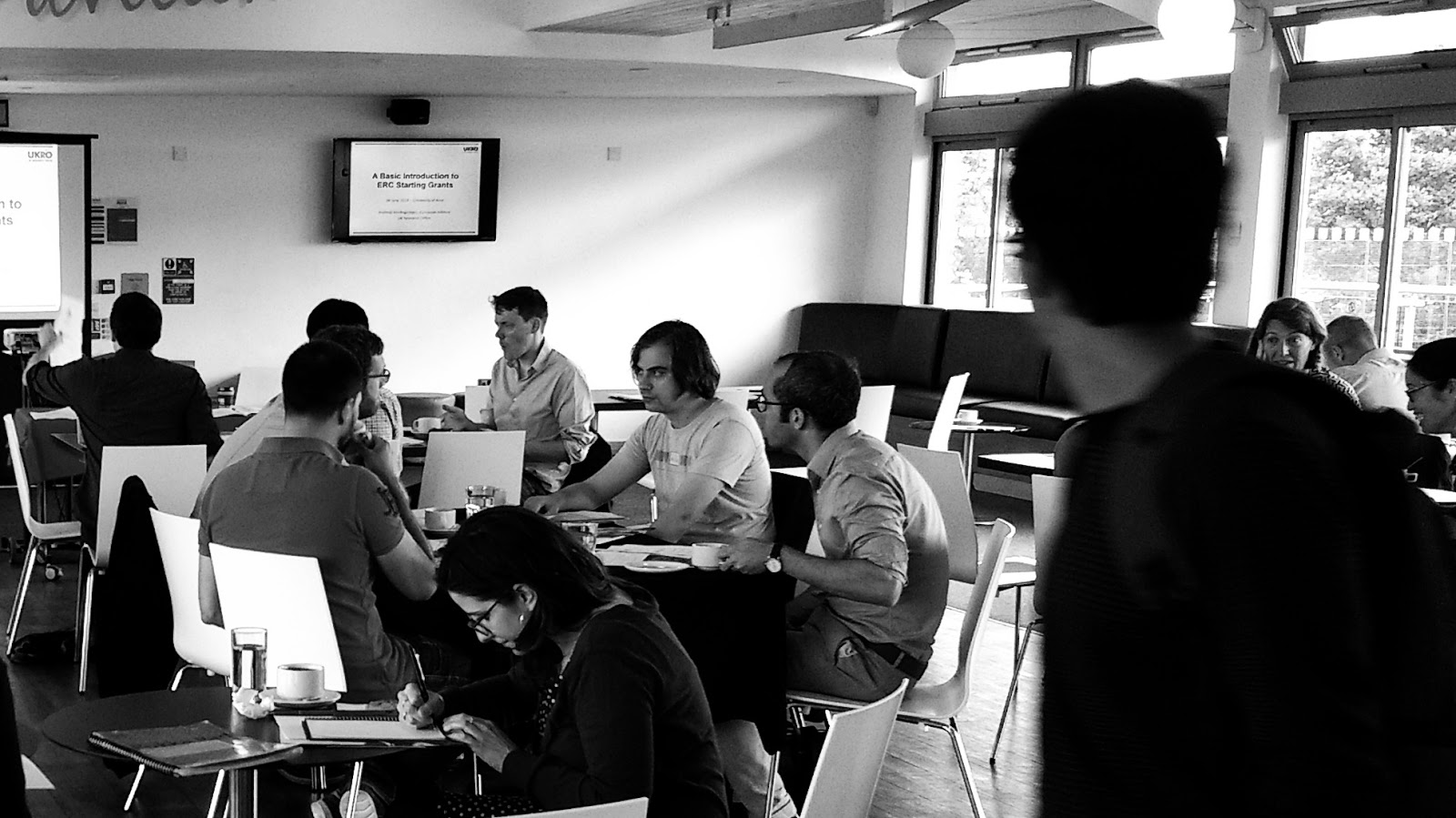 |
| The ERC Workshop last month |
The Project
Tracy is a paleoanthropologist, who looks at fossil remains to understand human evolution and development. Her €1.6m ERC-funded project, ‘GRASP’, examines two million year old hand bones to try and resolve two key questions in the field: did the earliest humans still use their hands to climb trees, and when did they start using tools.
The project uses innovative methods, including internal structural analysis using high-resolution microtomography (microCT).
Why Apply?
Tracy applied to the ERC in 2012, five years after getting her PhD. She was motivated to apply because her vision - and the research questions she was seeking to answer - required a large and complex project which was unlikely to be funded elsewhere.
Furthermore, the time was right for her. She had been at the Max Planck Institute, but neither her publication record nor her funding success were huge. However, she had had two high impact papers, including one as lead author that had made the cover of Science. In addition she was looking for a way to move back to the UK, as her partner was at UCL.
Writing the Application
‘Understanding the Participant Portal requires a degree in engineering’, Tracy joked, but her underlying point was well made: give yourself time to prepare and understand what’s required. But understanding the Portal was only the beginning, and Tracy mapped out a series of points to consider when preparing a bid.
Thursday, 13 April 2017
Grants Factory: Applying for Marie Curie ITNs
2-4pm, Wednesday 10 May 2017
Venue: TBC
 |
| Dr Richard Guest |
Marie Curie Innovative
Training Networks (ITNs) provide funding for doctoral training programmes
run jointly between a number of institutions across Europe. They run for up to
4 years and are worth up to €4.5m. There is no limit to the disciplines which
can apply, and the University currently has six ITNs running. One of these is Enhanced
Mobile Biometrics (AMBER) in EDA, led by Dr Richard
Guest.
The next call is due to open in the autumn with a deadline
early in the New Year. Despite the triggering of Article 50 UK universities can
still apply, and the
Treasury has agreed to underwrite any grants that have been approved at the
point the UK leaves the EU in March 2019. Richard has kindly agreed to talk
about his experience of applying for these complex grants, what worked for him,
what he would have done differently, and what people should bear in mind when
starting to develop the collaborations.
The session is free and open to all, and tea and coffee will
be provided. However, do drop me a line to let me know that you plan to come.
Friday, 17 March 2017
Bonfire of the Sanities

Since the EU Referendum last year, there has been a lot of uncertainty about what it will mean for UK academics. In the last edition of the Research Services' newsletter, Research Active, we looked at known unknowns, and why European funding is crucial to the University—and the UK as a whole.
Current Situation
Tuesday, 3 May 2016
How to Prepare a Successful ERC Application

Last Wednesday we hosted Maribel Glogowski, our UKRO
representative, who gave a thoughtful overview of the European Research
Council (ERC) and offered insights into how best to target the
funder. Dr Heather Ferguson, who recently won a
Starting Grant, joined her to offer an invaluable viewpoint from
someone who had been through the process.
Background
The ERC has been one of the great success stories of the
EC's Framework Programme. The prestigious, responsive mode fellowships were
clearly what the European research community wanted, and this was demonstrated
in the heavy oversubscription of the first call for Starting Grants in 2007,
when over 9,000 people applied for just 300 awards, giving a success rate of
just 3.4%.
Since then the situation has settled down, and now the
Starting Grant success rate is actually broadly in line with that of the ESRC
at 12%. In Horizon 2020, the ERC is part of the
'Excellent Science' pillar, which funds responsive mode research. Of the total
€24.2bn budget for the pillar, the ERC has almost half (€13.1bn). It provides
five types of grants:
●
Starting Grants:
up to €2m for 5 years for investigators 2-7 years from PhD
●
Consolidator
Grants: up to €2.75m for 5 years for investigators 7-14 years from PhD
●
Advanced Grants:
up to €3.5m for 5 years (no set career point restriction, but investigators
must be well established leaders in their fields)
●
Synergy Grants: up
to €15m for 2-4 investigators. The scheme is currently on hold.
●
Proof of Concept
Grants: for ERC award holders: up to €150k for 18 months.
Wednesday, 5 November 2014
Launch of the Kent EU Partnership Fund

Kent, as the UK's
European university, is strongly supportive of the development of
collaborations with European partners.
In order to facilitate these, funding is
available to cover the cost of developing exchanges and visits. Details of how
to access this Fund are now available on the Research Services website, here.
If
you have any questions about it, don’t hesitate to get in touch with me.
Wednesday, 14 May 2014
H2020: Taking Stock

We're now five months into Horizon 2020. We've had the first call deadlines, and it's time to take stock.
Monday, 15 April 2013
European Grants Factory - 9 May

12:00 – 13:00 An Overview of Horizon 2020
Sobia Aslam (UKRO)
Rutherford Lecture Theatre 2
Sobia Aslam from the UK Research Office in Brussels (UKRO) will provide an overview of the EU’s new funding programme for research, Horizon 2020. It will succeed Framework Programme 7 (FP7) in January next year. It has a proposed €80 billion budget (a 46% increase over FP7), will bring together both research and innovation, and is intended to simplify the process of applying to the EC. Draft work programmes will start to emerge over the summer, so now is an excellent time to find out more about the new framework.
In addition, Sobia will be holding a surgery session after lunch to discuss individual applications, or focus on specific issues. So if you have questions about H2020, or perhaps have a Marie Curie application on the go, get in touch to book a slot.
13:00-13:30 – Lunch
13:30-15:00 – European Funding: is it for me?
Prof Simon Thompson (Computing) & Jenny Billings (CHSS)
Rutherford Lecture Theatre 2
This is a rerun of last year’s sell-out seminar that offers a warts and all view of the European funding. The EC is notorious for the complexity of its applications, but unlike the UK funding for research is ringfenced and growing. Jenny Billings (CHSS) and Simon Thompson (Computing), both veterans of EU funding, offer their insights into the highs and lows of applying for, managing and reviewing European applications.
The events are free, but do let me know if you are planning to come so that I can make sure there’s enough space and catering for all.
Tuesday, 4 September 2012
Mists, Mellow Fruitfulness & ERC Deadlines

- Firstly, try and get a look at previously successful applications. This is true for any funder, of course, but perhaps more so for the EU, as people are often confused by the specific language and structure that is expected. Seeing how someone else has done it really helps.
- Secondly, and following on from this, make sure you 'give them what they want'. Look at the criteria, and make sure you are meeting them. These grants are about you and your project: be clear why you are the right person with an exciting, ground breaking project at the 'frontier' of knowledge.
- In turn, leading on from this, the ERC are looking for something different. Perhaps more than any other funder, this is the chance to take risks, to do something challenging. So use your imagination and think big - but couch it in a robust managerial framework that will reassure those of a nervous disposition.
- Get feedback. Lots of feedback. Here at Kent we've got the Internal Peer Review system, so get in touch with us as early as possible. But get feedback elsewhere, too: your proposal needs to be easily understood and inspiring by people who might not know the field, and whose first language may not be English.
- Submit early and often. Each time you submit it overwrites your last version. Don't leave it until the last minute when there will be, inevitably, a software crash.
- If you're shortlisted for interview, prepare throughly. Set up a mock panel (we can help with this) and go through a dry run. Take on board the feedback. Go over to Brussels the day before the actual interview and scout out the terrain. You don't want to get lost and arrive breathless, confused and red faced, or get derailed by Eurostar holdups.
- At the interview, they will use reviewers' comments to question your proposal. You won't have seen these, but try and pre-empt them by thinking what elements of your project will be seized on.
- Finally, think of the poor panel. Not only will they have ploughed through hundreds of applications, but they then have to sit for days in a small, stuffy room watching anxious academics perform. Engage them, and be enthusiastic and confident.
Thanks to Jo Frost at UKRO for running these events, and to Dr Lawrence Moon of KCL for sharing his experiences of applying to the ERC.
The Consolidator Grants came later, on 21 Feb, so annoyingly don't fit neatly into my Keatsian reference. But we never let the truth get in the way of a glib opening sentence here at Fundermentals Towers.
Monday, 9 July 2012
Preparing a European Funding Presentation: a Beginner's Guide

- First, there's no such thing as too much text. What we need is words, and lots of them;
- Second, include absolutely all the detail about the development of the policy that underlies any scheme or programme, however unnecessary it might seem. If you could include a timeline of the negotiations that led to the adoption of that policy, that would be a bonus. Extra points can be scored by inserting a picture of the front of the policy document, entitled something like '2017: Towards a more Integrated, Forward-Looking Europe';
- Third, acronyms, acronyms, acronyms. Make sure you have at least 15 per slide, and never, ever explain them. Other than quickly, under your breath, in passing.
- Fourth, you need a flow chart. Doesn't matter what it represents. Plenty of arrows, preferably doubling back on themselves or at least double ended.
- Fifth, you must include some clip art, ideally circa 1995. If you could combine this with a garish use of colours or an eclectic mix of fonts, so much the better. If you no longer have access to your Office95 clip art suite, you can substitute these for some generic pictures of groups of young European people smiling, preferably with books clutched to their chests.
- Finally, as EC Directive 2045/12-ZD makes clear, all EC-related presentations have to end with a chirpy, 'Thank You for your Attention!' slide.
With these simple building blocks in place your success is assured, and you can look forward to a career of conference coffee and gazing out at rooms full of confused looking delegates.
Thank You for your Attention!
Friday, 11 May 2012
H2020 Negotiations: a Helpful Diagram
I know you're all itching to know what the timetable will be for the negotiations over the next Framework Programme, Horizon 2020. Well itch no more. Here is a brief run down of the run up to its glorious launch in January 2014.
- May 2012: European Parliament’s Industry, Technology, Research and Energy (ITRE) Committee publishes report on H2020.
- June 2012: Parliament publishes amendments to the proposals.
- July 2012: final calls to FP7.
- Nov/Dec 2012: Parliament votes on proposals. The European Council (made up of national science ministers) will vote around the same time.
- Dec 2012/Jan 2013: discussion (or, if you will, a trialogue) between the Commission, Council and Parliament about the proposals and amendments.
- June 2013: agreement should have been reached.
- Dec 2013: Adoption of legislative acts by Parliament and Council that will bring H2020 into force.

Monday, 16 April 2012
Events of May
 It's like 1968 all over again. Sort of. Well, a lot of the events we've got planned may well mark 'the beginning of a prolonged struggle'. But be brave! Come along to one of the many events we've got planned, and we'll help you in the (funding) struggle. All are free, there are refreshments, and all staff are
welcome, but do let me know if you would like to attend any or all of them
so that I can get an idea of numbers.
It's like 1968 all over again. Sort of. Well, a lot of the events we've got planned may well mark 'the beginning of a prolonged struggle'. But be brave! Come along to one of the many events we've got planned, and we'll help you in the (funding) struggle. All are free, there are refreshments, and all staff are
welcome, but do let me know if you would like to attend any or all of them
so that I can get an idea of numbers.4 May: UKRO VISIT
- European Research Council Starting Grants (Keynes LT3, 12:30 -2pm) The next round of European Research Council Starting Grants is due to open in July, with deadlines early in the new year. These grants are very generous, offering those with 2-12 years postdoc experience up to €1.5m for 5 years. Competition is fierce, but success rates are on a par with those for Research Councils. Jo Frost, our Brussels’ UK Research Office (UKRO) rep, will provide an insight into these grants, and Funding Officers will be on hand to offer practical advice about
- Marie Curie Fellowships (Keynes LT3, 2pm – 3:30pm) Jo Frost will follow up her ERC talk by providing more information on the Marie Curie Fellowships. These are intended to encourage mobility for researchers within Europe. They can be on an individual basis, or as a network. The MC schemes are popular, and they have recently been revised by the EC. Jo will tell us more about these changes, and what the Commission has planned for the next Framework Programme.
9 May: EUROPE DAY
- PVC LUNCHTIME SEMINAR: ‘Europeanisation’ (Peter Brown Room, Darwin, 12:30-2pm) To mark Europe Day a special PVC’s Lunchtime Seminar will look at ‘Europeanisation.’ The Seminars offer a chance to find out about what research is happening across the University, and to meet others outside your School. The speakers are:
Simone
Glanert (Law): ‘How
‘Common' Is a Common Law Without a Common Language and a Common
Discourse: (Uncommon) Thoughts on the European Union’.
Ben Hutchinson
(SECL): ‘International Challenges for National Archives’.
Roger
Vickerman (Economics): ‘Economic integration through regional and
transport policies in Europe’.
Paolo
Dardanelli (Politics & IR): ‘European integration, party strategies, and state restructuring’.
- GRANTS FACTORY: ‘Eurovision: the Pros and Cons of European Funding’ (Peter Brown Room, Darwin, 2pm-3:30pm) This is a rerun of last year’s sell-out seminar that offers a warts and all view of the European funding. The EC is notorious for the complexity of its applications, but unlike the UK funding for research is ringfenced and growing. Jenny Billings (CHSS) and Simon Thompson (Computing), both veterans of EU funding, offer their insights into the highs and lows of applying for, managing and reviewing European applications. Places are limited, so book early.
10 May: UNDERSTANDING & APPLYING TO THE NATIONAL INSTITUTE OF HEALTH (NIHR) (Senate Building, 10am-4:30pm) Government funding for health-related research is distributed by the MRC and the NIHR. The MRC deals with basic research, the NIHR with research that will affect the NHS, including social care and public health research. Last year it gave out £210.5m of research grants through a range of programmes. This event will be a chance to understand how these differ and fit together. The programme will include talks by members of NIHR, as well as those who have had NIHR funding, and have helped with applications in the past. The full programme can be seen on the blog, here.
30 May: GRANTS FACTORY:
Writing Better Bids (Venue TBC, 10am-12pm) This perennial
favourite runs three times a year, and provides those attending with an
overview of what makes a good application, and how to draft your application so
that it is clear, readable and convincing. David
Shemmings provides insights based on the ’Grants Factory’ method developed
by Prof Andrew Derrington (formerly Dean of Social Sciences, now PVC at Liverpool)
and Jacqueline Aldridge. These are always well attended; book now if
you’re planning to draft a proposal.
Tuesday, 14 February 2012
The End is Nigh

And now, the end is near....yes, we're in to the final stretch of FP7, and we're beginning to get notification of the last of the deadlines. Dry your tears, and start preparing those applications. Here are the provisional details of the last round of Marie Curie grants:
- Initial Training Networks: 22 November 2012
- Researchers' Night: 10 January 2013
- International Research Staff Exchange Scheme: 17 January 2013
- COFUND: 5 December 2012
- Career Integration Grants: 7 March 2013 and 5 September 2013
- Industry-Academia Partnerships and Pathways: 15 January 2013
- Intra-European Fellowships: 14 August 2013
- International Incoming Fellowships: 14 August 2013
- International Outgoing Fellowships: 14 August 2013
Thursday, 1 December 2011
Horizon 2020 Proposal Published

Get ready with the party poppers. Cue the scratchy copy of 'Ode to Joy' on the turntable. Don the cardboard hats depicted the flags of all (EU) nations. For yesterday the EC officially published the proposal for Horizon 2020. Hurray!
This marks the formal beginning of the new Framework Programme, by which the European Commission will distribute its research funding. There's been plenty of rumour and discussion as it has developed so far, but the publication yesterday gives us the starting point for the EC's negotiations with the European Parliament and Council, before the proposals are adopted at the end of 2013, and H2020 begins in January 2014.
Better still, there's a page on which a new video will be added each day in the run up to the launch of Horizon 2020. That's 731 videos! I bet after the first 100 they'll be running short of ideas and taking the best viral hits from YouTube as their own. Watch out for an appearance by Benton/Fenton.
In summary, the Commission has proposed a budget of €80bn for the seven year Framework. It will be based on three specific objectives:
1. Excellent Science (EUR 24.6 billion) which will include:
In summary, the Commission has proposed a budget of €80bn for the seven year Framework. It will be based on three specific objectives:
1. Excellent Science (EUR 24.6 billion) which will include:
- European Research Council (EUR 13.2 billion; 77% increase compared to FP7 funding for ERC);
- Future and Emerging Technologies (FET) (EUR 3.1 billion);
- Marie Curie Actions (EUR 5.75 billion) ; and
- Research Infrastructures (EUR 2.4 billion).
- Key industrial technologies: nanotechnologies, information communication technologies, biotechnologies and space (EUR 13.7 billion);
- Access to risk finance (EUR 3.5 billion); and
- Support to SMEs with high growth potential.
- Health, demographic change and well-being;
- Food security, sustainable agricultures, marine and maritime research and the bio-based economy;
- Secure, clean and efficient energy;
- Smart, green and integrated transport;
- Climate action, resource efficiency and raw materials; and
- Inclusive, innovative and secure societies.
- innovation for healthy living and active ageing;
- food4future; and
- raw materials.
So watch this space as the proposal develops, and make sure to visit the EC's own Video Vault. Thanks, as ever, to UKRO for the headsup on this.
Thursday, 1 September 2011
Forthcoming European Funding Events

Part of the problem with going on holiday - or rather, the coming back - is remembering what you've already publicised and what you haven't. I don't think I've mentioned these on the blog yet. If I have, well, nod politely, smile wanly, and pass on.
We’ll be running a couple of European Funding events this year:
- European Funding Clinic (12-2pm, 15 September) This is intended for people who are applying to the current FP7 calls. It will be an opportunity for applicants to present and discuss their proposals with two experienced academics (Simon Thompson and Jenny Billings) who have been applicants, grant holders and reviewers for the EC.
- Eurovision: Is European Funding for Me? (w/c 7 May, TBC) This will be a rerun of the well-attended event in January. It will look, honestly, at the pros and cons of European funding, and may include an overview of any draft Work Programmes we have at that point.
Saturday, 9 July 2011
What the FET's it All About?
 Now here’s a hidden gem. At a time when funders are increasingly risk averse and focused on established academics, the EU is providing funding for technology projects undertaken by anyone at any stage of their career that are inherently uncertain. The Future and Emerging Technologies (FET) scheme funds research that seeks fundamental understanding, but that is inspired by everyday problems. Think Louis Pasteur.
There are three schemes within FET:
- FET-Open: bottom up funding for small scale, novel and fragile ideas. It has a light 2 step assessment process, and an open deadline.
- FET-Proactive: top down ‘managed’ funding that focuses on transformative, thematic research and emerging communities. It’s targeted and is aimed at developing a critical mass. There are fixed deadlines.
- FET-Flagships: One step up from the ‘FET-Proactive’ are these large, roadmap-driven research initiatives.
- Challenging Current Thinking (€75m): Provides funding for 3-6 partners, with each award of about €1.5 – 3m. They’re looking for new and alternative ideas that are risky and unconventional. They don’t want research that just provides incremental improvements. It’s all about foundational breakthroughs, ambitious proofs of concept, and new, interdisciplinary collaborations.The success rates initially appear low: 4%. But that’s the total number of outline applications divided by the total number of projects finally funded. If you use the more realistic number of full applications divided by the number of awards, it’s a much more respectable 35%.
- High Tech Research Intensive SMEs in FET Research (€9m): This provides funding for research outside large labs. Like the ‘Research for the Benefit of SMEs’, this is intended for SMEs who are willing to take the driving role in research, and get the primary benefit from it. The EC is not interested in projects that seek short term commercial outcomes.
- FET Young Explorers (€6m): This is aimed at catching the creativity, potential, and openness of young researchers, and to develop their leadership, empowering them to be independent. By ‘young’ they mean less than 6 years from the submission of their PhD.
- International Cooperation Top up Call (€3m): This provides funding to extend existing FET projects with complementary research activities that develop collaborations with new non-EU research partners. It’s restricted to on-going FET projects, and there must be 18 months left of the award.
- Science of Global Systems (€3.5m): Here, they are seeking IT projects that are developing models that will be used to understand global systems – eg ecological, socio-economic – and improve their ability to respond to changes. There’s a deadline 17 Jan 2012.
Monday, 28 March 2011
Find a Name for FP8
 Don't you just love it? Something to cheer you up on a Monday morning. The EC has launched a competition to name the new framework programme. No, no, none of that 'FP8' talk at the back!
Yes, it's all a bit Multi-coloured Swap Shop, but none the worse for it. So think of a name, ideally something that sums up your experience of European funding, with an acronym that isn't a word for a bodily function in any of the EC's 23 official languages.
Hmm...it's harder than I thought...
You can submit your entries here by 10 May 2011. The winning name will be announced by Commissioner Geoghegan-Quinn at the Common Strategic Framework conference in Brussels on 10 June.
Thursday, 10 March 2011
ERC: Rumours of a New Collaborative Grant Scheme
 Hot on the heels of the news that the ERC would be rolling out a new 'Proof of Concept' scheme (which will probably be launched on 17 March), the word on the funding street is that the Council is planning a fourth scheme.
Provisionally called 'ERC Plus', my understanding is that it will provide funding for more collaboraitve research than is currently offered by the two current schemes. Thus, you will be expected to have between 2 - 4 investigators, all of whom should have a stellar track record. The intention is that ERC Plus projects will be 'more than the sum of their parts.' Together, the investigators will achieve more.
Initial signals are that it will have a 'pilot' round, offering €15om, with consortia able to apply for up to €15m for up to 6 years. So expect a rush of applications and resultant poor success rates. Keep an eye on the ERC website as details of the scheme are unveiled, probably when the next Work Programme is published.
Thursday, 20 January 2011
Notes from 'European Funding: Is It for Me?'
A packed room listened to Prof Simon Thompson, Jenny Billings and Andy Smith give their personal thoughts on European funding yesterday. All have had considerable experience in dealing with the European Commission: Simon has had funding via the Framework Programme, Jenny from a number of other streams, and Andy works for UKRO, the UK Research Office in Brussels, which provides advice and insight on European funding for the UK research community.
Pros and Cons
 Andy started by giving an overview of the pros and cons of applying for European funding. He started with the ‘cons’, which recognised the fact that it’s complicated, bureaucratic, acronym-riddled, and inconsistent, with low success rates for some schemes and a ‘top down’ structure which leaves some disciplines out in the cold. However, these are balanced with considerable ‘pros’: the Framework programme handles a huge (€52bn) pot of funding, which is ring-fenced and increasing over the next three years. It allows you to think internationally, to be flexible in whom you work with, and offers good career development opportunities. It’s prestigious, offers great opportunities for exploiting and developing your work, and the success rates for UK institutions bucks the average across Europe with a respectable 23%.
Applying for Funding
Simon followed this by describing his experience of applying to the Framework Programme. He explained the process he went through to turn a single good idea into a complicated 80 page proposal. This might seem like a nightmare for many, but but there are some similarities with domestic funding. Roughly the same amount of detail is needed, but, because there are more partners and a bigger budget, the quantity of information is greater. However, the EC does gives equal weighting to the assessment of the 'science', the project management and the impact. This differs from Research Councils, which focus mainly on the scientific quality. In addition, unlike the Research Councils, the EC mainly issues 'calls for proposals', so you will have to respond to what it considers important. Finally, you have to work as a group, and manage conflicting demands from the participants.
If you’re interested in developing a proposal, how do you build a consortium? Simon suggested starting with a one page outline. This gives potential participants an idea of what you intend to do. Each participant must justify their inclusion, and regular discussions are crucial. Face to face meetings are best (and could be added to a conference trip), but Skype offers great – and free – opportunities for conference calls. The drafting of the proposal should not be left with one individual, and should ideally be shared between two or three, with people pairing up to write. Don’t email each other amended versions of the proposal: this leads to confusion. Instead, use a web-based repository, such as Dropbox (www.dropbox.com), to hold a ‘master copy’ of the proposal.
A good starting point when preparing a proposal is to look at previously successful applications for clues about wording, ideas, and approaches that have worked before. You can even use some of the ‘boilerplate’ text for your own proposal. As you work up the proposal, get feedback from colleagues, UKRO, and Research Services. You might be too close to it to be able to judge it objectively. Read the Guide for Applicants, the Work Programme and the Guide for Reviewers to get a better idea of what the EC is expecting.
Pros and Cons
 Andy started by giving an overview of the pros and cons of applying for European funding. He started with the ‘cons’, which recognised the fact that it’s complicated, bureaucratic, acronym-riddled, and inconsistent, with low success rates for some schemes and a ‘top down’ structure which leaves some disciplines out in the cold. However, these are balanced with considerable ‘pros’: the Framework programme handles a huge (€52bn) pot of funding, which is ring-fenced and increasing over the next three years. It allows you to think internationally, to be flexible in whom you work with, and offers good career development opportunities. It’s prestigious, offers great opportunities for exploiting and developing your work, and the success rates for UK institutions bucks the average across Europe with a respectable 23%.
Applying for Funding
Simon
 followed this by describing his experience of applying to the Framework Programme. He explained the process he went through to turn a single good idea into a complicated 80 page proposal. This might seem like a nightmare for many, but but there are some similarities with domestic funding. Roughly the same amount of detail is needed, but, because there are more partners and a bigger budget, the quantity of information is greater. However, the EC does gives equal weighting to the assessment of the 'science', the project management and the impact. This differs from Research Councils, which focus mainly on the scientific quality. In addition, unlike the Research Councils, the EC mainly issues 'calls for proposals', so you will have to respond to what it considers important. Finally, you have to work as a group, and manage conflicting demands from the participants.
If you’re interested in developing a proposal, how do you build a consortium? Simon suggested starting with a one page outline. This gives potential participants an idea of what you intend to do. Each participant must justify their inclusion, and regular discussions are crucial. Face to face meetings are best (and could be added to a conference trip), but Skype offers great – and free – opportunities for conference calls. The drafting of the proposal should not be left with one individual, and should ideally be shared between two or three, with people pairing up to write. Don’t email each other amended versions of the proposal: this leads to confusion. Instead, use a web-based repository, such as Dropbox (www.dropbox.com), to hold a ‘master copy’ of the proposal.
A good starting point when preparing a proposal is to look at previously successful applications for clues about wording, ideas, and approaches that have worked before. You can even use some of the ‘boilerplate’ text for your own proposal. As you work up the proposal, get feedback from colleagues, UKRO, and Research Services. You might be too close to it to be able to judge it objectively. Read the Guide for Applicants, the Work Programme and the Guide for Reviewers to get a better idea of what the EC is expecting.
Reviewing and Managing Projects
Jenny took over to talk about how proposal are reviewed. The application will be judged on three criteria, and you must make sure you meet all of these.
- Scientific Excellence: this is the ‘meat’ of the proposal, and you should describe your objectives (in line with the call), what the state of the art is, and how your proposal will advance this;
- Quality and Efficiency (Management): are the consortium members both excellent and appropriate, and do they have the necessary experience?
- Impact: explain the impact of your previous research, and think of ways of explaining how the impact of this project will be effectively felt – eg concentric circles, Venn diagrams, etc. Don’t neglect academic impact, and think about potential impact in other disciplines.
Each of these need to achieve a score of 3/5, with a total of at least 10/15. However, if your proposal scrapes through with 10 or 11, the chances are that it won’t get funded, even though it’s got through to the second stage of the assessment. Make sure that your proposal ‘grabs’ the reviewers: they should have a clear idea of what your plans are by the end of the first page. Part of the review process involves them getting together in Brussels for a meeting that can take days, to reach a consensus on a prioritisation list. Give them enough detail and evidence to back up their opinions and bear in mind that the majority might not have English as their first language.
You should also consider what happens ‘after the birth’. There’s a lot of support prior to submission, but you might feel slightly abandoned once the award is made and you have to manage the grant. Managing the partnership effectively is crucial, and consortia have recently been given more powers to expel members who are not performing effectively and doing the work specified. Make contact and develop good relationships with the accounts team in Research Services, who will help with the financial management of your grant, including the completion of timesheets and making claims. There will be annual project reviews, and you need to make sure you are well prepared for these.
In addition, you should recognise the European stereotypes, and be happy to work with them!
The slides from this event are available. Drop me a line if you'd like a copy.
Subscribe to:
Posts (Atom)