Although the draft work programmes for the EC's new Framework Programme, Horizon Europe, are being leaked and the Portugese presidency is making it a priority to get things moving on it, the main question has yet to be answered: what's the logo for it, and how does it compare to previous iterations? Fortunately, fearless Fundermentals is here to help.
Showing posts with label EC. Show all posts
Showing posts with label EC. Show all posts
Friday, 22 January 2021


Tuesday, 31 March 2020
How Does the Coronavirus Lockdown Affect Funding Applications?
 |
| Most funders are aiming to keep open for business as usual - so get typing. (Photo by Patrick Fore on Unsplash) |
Every part of our lives has been affected by the current lockdown to tackle the Covid-19 outbreak, and the world of research funding is no exception. Some funders are postponing the deadlines for some or all of their schemes, while others are trying to continue as normal. Here we summarise what we know so far.
Wednesday, 15 January 2020
Beyond the Horizon
 |
| The long goodbye |
With the UK due to leave the European Union on 31 January 2020, what’s ahead for international research funding for UK researchers?
Wednesday, 18 December 2019
Fundermentals Top 10 2019

Well, as ever, you can trust Fundermentals to do the wrong thing. Here, with a reminder of every twist and turn of the Year that Brexit Never Was, is the top ten most popular articles on the site this year.
Thursday, 28 March 2019
Research England Launches 'Old MacDonald' Funding Suite
 |
| On the farm: E-I--E-I-O (Photo by Stijn te Strake on Unsplash) |
Not to be outdone, the newly-flush Research England is making great headway in
Thursday, 24 May 2018
What's on the Horizon?
 |
| Cue 'Ode to Joy' (photo: Phil Ward) |
Thursday, 22 February 2018
Rodney Takes over European Research
In a surprise move, seen by some as offering a soothing pat on the head to the off shore asylum formerly known as Britain, the European Commission has appointed Rodney Trotter as the new Director General of DG Research and Innovation.
He succeeds long term incumbent Harvey Keitel, who held the position for eight years. He was a highly regarded Director General, but great things are expected of his successor.
'He knows how to hold his nerve and remain steady,' said an unnamed source very very very close to Jean-Claude Junker. 'Although he appears to be playing second fiddle to a loudmouth chancer with delusions of grandeur, he actually has very little to do with David Davis - I mean Jason,' he quickly corrected.
Any similarity to Jean-Eric Paquet is, of course, entirely coincidental.
He succeeds long term incumbent Harvey Keitel, who held the position for eight years. He was a highly regarded Director General, but great things are expected of his successor.
'He knows how to hold his nerve and remain steady,' said an unnamed source very very very close to Jean-Claude Junker. 'Although he appears to be playing second fiddle to a loudmouth chancer with delusions of grandeur, he actually has very little to do with David Davis - I mean Jason,' he quickly corrected.
Any similarity to Jean-Eric Paquet is, of course, entirely coincidental.
 |
| Trotter |
 |
| Paquet |
Thursday, 14 December 2017
Who Ya Gonna Call?
 |
| Downtown Brussels. Help is just a phonecall away (photo: Elliott Brown) |
Monday, 30 October 2017
Grants Factory: ERC Masterclass
Thursday 9 Nov, 12pm-2pm
Cornwallis LT3 (COLT3), Canterbury campus
 |
| Our last ERC masterclass |
The ERC or European Research Council is the gold standard of European research funding. There are no research boundaries or priorities, all topics are supported from arts to medicine, from social science to engineering. Each year hundreds of the very best researchers are supported by the ERC to pursue their own, transformative research ideas in Europe. They are, quite simply, 'career-making' grants.
If you
are thinking of applying to the ERC in 2018 this is the time to start
preparing, particularly for the ERC Consolidator call.
Tuesday, 25 July 2017
Advice on Applying for an ERC Starting Grant
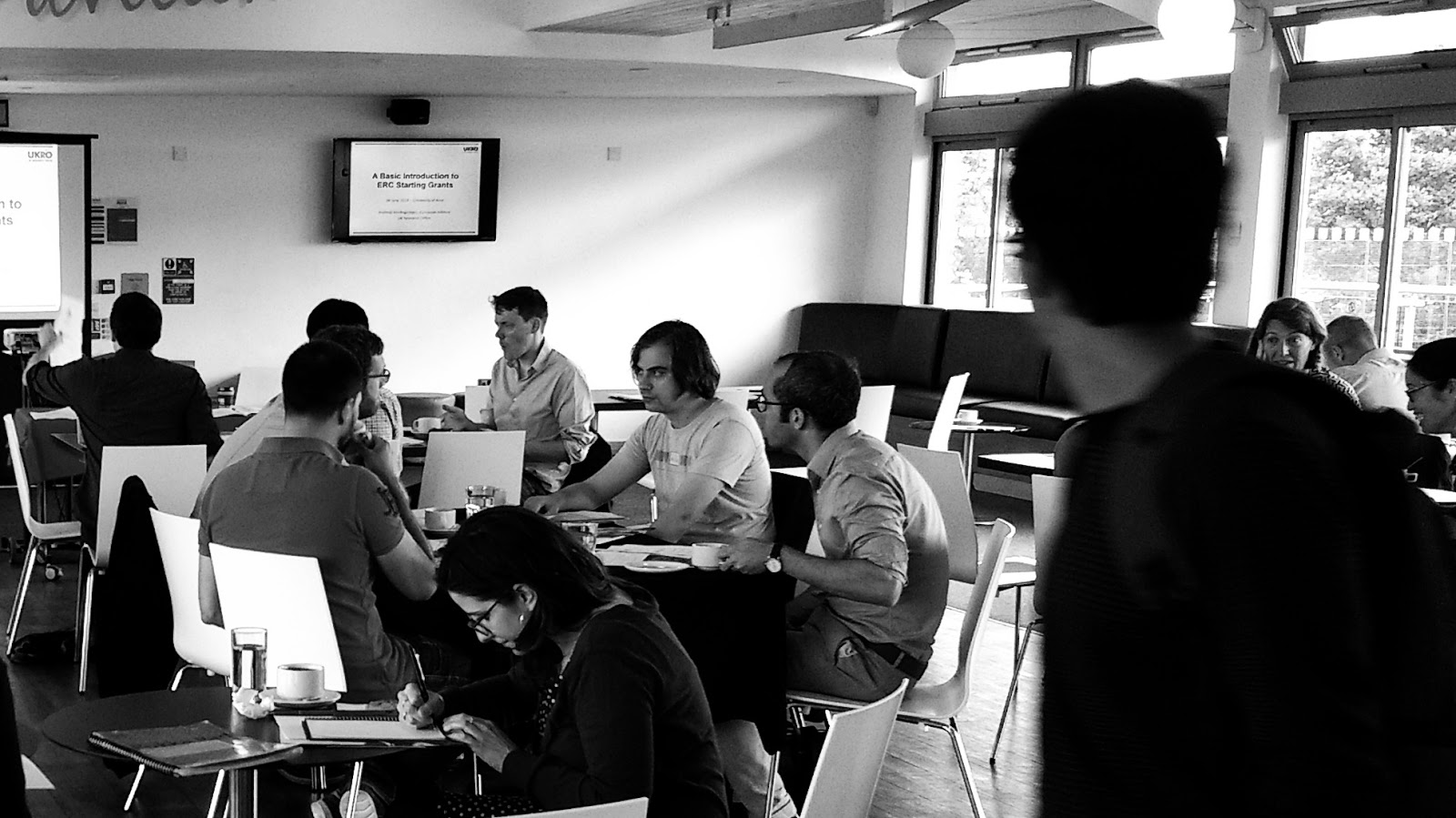 |
| The ERC Workshop last month |
The Project
Tracy is a paleoanthropologist, who looks at fossil remains to understand human evolution and development. Her €1.6m ERC-funded project, ‘GRASP’, examines two million year old hand bones to try and resolve two key questions in the field: did the earliest humans still use their hands to climb trees, and when did they start using tools.
The project uses innovative methods, including internal structural analysis using high-resolution microtomography (microCT).
Why Apply?
Tracy applied to the ERC in 2012, five years after getting her PhD. She was motivated to apply because her vision - and the research questions she was seeking to answer - required a large and complex project which was unlikely to be funded elsewhere.
Furthermore, the time was right for her. She had been at the Max Planck Institute, but neither her publication record nor her funding success were huge. However, she had had two high impact papers, including one as lead author that had made the cover of Science. In addition she was looking for a way to move back to the UK, as her partner was at UCL.
Writing the Application
‘Understanding the Participant Portal requires a degree in engineering’, Tracy joked, but her underlying point was well made: give yourself time to prepare and understand what’s required. But understanding the Portal was only the beginning, and Tracy mapped out a series of points to consider when preparing a bid.
Friday, 17 March 2017
Bonfire of the Sanities

Since the EU Referendum last year, there has been a lot of uncertainty about what it will mean for UK academics. In the last edition of the Research Services' newsletter, Research Active, we looked at known unknowns, and why European funding is crucial to the University—and the UK as a whole.
Current Situation
Thursday, 28 January 2016
The Story of O
 |
| Ob La Di, Ob La Da: 'Important' |
Whilst Fundermentals is entirely behind any policy directives based on random letters of the alphabet, we feel that Moedas has missed a trick by limiting his agenda to these three Os. They're all very well, but they're a little - well - humdrum. These Os won't set the world alight. They won't inspire the next generation of young European scientists.
Tuesday, 8 December 2015
H2020 Grant Application Wins the Turner Prize
 |
| Excited members of 'ENdlessDIsapPOINTment' yesterday |
To shouts of astonishment, the judges announced that the collective, known by their project acronym 'ENdlessDIsapPOINTment', had secured the prize for 'a ground-up approach to recycling an idea multiple times.'
Saturday, 10 October 2015
Engaging with Europe

In April I wrote about the European Research Area, the ‘borderless continent’ that the founding fathers of the European Union hoped to achieve. The ERA can best be seen as a work in progress, but that shouldn’t stop academics from engaging with it and trying to influence its future direction and focus.
To many, the European Commission can seem like an impenetrable technocracy. If you ever hear a commissioner speak, it will do little to dispel this notion. I wrote once about the basic components of a Commission presentation. The vital elements are PowerPoint slides dense with text, detailed maps of the process by which directives have been agreed, preferably involving an incomprehensible flowchart, lots of clip art, and a peppering of unexplained acronyms.
Monday, 25 May 2015
H2020: Year One Report Card

We have already had 79 calls, and researchers across Europe have responded by submitting 25,903 proposals, asking for some €41bn. Around 14.5% of these have been successful (3,765), totalling €6.6bn. That’s around 8.5% of the total H2020 budget of €70bn for the seven year programme.
Wednesday, 14 May 2014
H2020: Taking Stock

We're now five months into Horizon 2020. We've had the first call deadlines, and it's time to take stock.
Friday, 4 October 2013
'Funderland' (TM)
 |
| The ERC HQ: Heaven |
But before revealing my genius, let's take a step back and see how the idea came to be.There were two triggers, which both came from the recent trip:
- The Parliamentarium. This is the latest effort by the EU to convince all the naysayers that the Parliament is not just an expensive way to straighten our bananas, but has actually, y'know, stopped neighbours tearing chunks out of each other for the last sixty years. And you know what? It's actually very good. What could potentially have been a deathly tour into the minutiae of supranational legislative processes is actually presented in such a way that it inspires and cheers you. So what if they straighten a few bananas? They've found a way of getting people to talk to each other on equal terms. Museums tend to dwell on warfare and horror, on sacrifice, grimness and, well, pustules. But here was one that focused on quiet determination and success through bureaucracy. That's quite a feat for visitors' centre.
- The ERC Headquarters. Like the poisoned characters entering Heaven at the end of Monty Python's The Meaning of Life, we stared around at our surroundings in disbelief. Choirs of angels sang away in the distance. Lions lay down with lambs amongst the verdant greenery. Little elfin children skipped happily around around our feet. This was the entrance to the Covent Garden Building which houses the ERC. It was exciting enough to be at the epicentre of pure research in Europe, the beating heart of the beast that discards all other criterion in favour of Excellence. But for the reality to match my dream! It was almost too much.
Which is when I came up with my Great Idea. A visitors' centre - nay, a visitors' experience - based around research funding. If some American fella can build one around an oversized mouse, then surely, surely there's room for Funderland (TM)? Obviously, the details are still to be finalised, but here are some broadbrush ideas:
- 'Doom': This gives the public a sense of the grant writing process. It's a log flume ride. First, you go through a long dark tunnel that at times seems endless. You lose the will to live and are just praying for it to be over. However, before you know it the end is in sight and you start to panic. 'Wait!' you think, 'I'm not ready!' Whoosh you go, down the flume, and you feel momentarily exhilarated. This doesn't last. A big rubber hammer marked REJECTION hits you on the head and you enter the tunnel again.
- 'High n' Low': This is a giant, swooping rollercoaster that tries to reflect the typical reviews and grades for a funding proposal. Extreme highs! Unjust lows! Breathtakingly short! Interminably long! It's all here.
- 'Herding Cats': For animal lovers, FP7 coordinators and research administrators everywhere. You're given 13 cats, a rattle and a short piece of string. You have to try to herd all 13 cats through a complicated maze before the 'Submit' klaxon sounds.
- 'The Treadmill': There's a giant screen showing Isaac Newton, Charles Darwin and Albert Einstein doing a big, complicated experiment involving lots of expensive machines. They've just reached a point where they're about to solve a big, complicated question when - oh no! - the screen flickers and fades! It turns out that the screen is powered by sixteen treadmill 'grant' generators. Each has to be constantly kept going. If a visitors gets bored and steps off, someone else better step up! Ah the joys of the big project!
- 'Let's Interdisciplinate!': Visitors are given a random selection of five household objects. They have to work out how each can inform the others, and can benefit from the experience of the others.
Monday, 9 July 2012
Preparing a European Funding Presentation: a Beginner's Guide

- First, there's no such thing as too much text. What we need is words, and lots of them;
- Second, include absolutely all the detail about the development of the policy that underlies any scheme or programme, however unnecessary it might seem. If you could include a timeline of the negotiations that led to the adoption of that policy, that would be a bonus. Extra points can be scored by inserting a picture of the front of the policy document, entitled something like '2017: Towards a more Integrated, Forward-Looking Europe';
- Third, acronyms, acronyms, acronyms. Make sure you have at least 15 per slide, and never, ever explain them. Other than quickly, under your breath, in passing.
- Fourth, you need a flow chart. Doesn't matter what it represents. Plenty of arrows, preferably doubling back on themselves or at least double ended.
- Fifth, you must include some clip art, ideally circa 1995. If you could combine this with a garish use of colours or an eclectic mix of fonts, so much the better. If you no longer have access to your Office95 clip art suite, you can substitute these for some generic pictures of groups of young European people smiling, preferably with books clutched to their chests.
- Finally, as EC Directive 2045/12-ZD makes clear, all EC-related presentations have to end with a chirpy, 'Thank You for your Attention!' slide.
With these simple building blocks in place your success is assured, and you can look forward to a career of conference coffee and gazing out at rooms full of confused looking delegates.
Thank You for your Attention!
Friday, 22 June 2012
Science: It (Must Be a Borat) Thing
It's been a joy to follow today's Twitterstorm over the EC's 'Science: It's a Girl Thing' video. The video itself is pitched so perfectly that you can't help thinking that the EC drafted in Chris Morris or Sacha Baron Cohen to write and direct it. From the fixation on make up, to the music video styling, it's jaw droppingly awful. You watch it thinking, 'is this for real?'
Whilst I don't think it will attract any more women into the lab, I don't think it will put anyone off either. Women - and men - are more media savvy these days; they won't be swayed by this nonsense, and will recognise that it has nothing to do with real science.
Let's look on the bright side: it has, for better or worse, highlighted the issue of the gender imbalance in the lab. For a bit of Friday light relief, take a couple of minutes to watch it yourself:
Whilst I don't think it will attract any more women into the lab, I don't think it will put anyone off either. Women - and men - are more media savvy these days; they won't be swayed by this nonsense, and will recognise that it has nothing to do with real science.
Let's look on the bright side: it has, for better or worse, highlighted the issue of the gender imbalance in the lab. For a bit of Friday light relief, take a couple of minutes to watch it yourself:
Friday, 11 May 2012
H2020 Negotiations: a Helpful Diagram
I know you're all itching to know what the timetable will be for the negotiations over the next Framework Programme, Horizon 2020. Well itch no more. Here is a brief run down of the run up to its glorious launch in January 2014.
- May 2012: European Parliament’s Industry, Technology, Research and Energy (ITRE) Committee publishes report on H2020.
- June 2012: Parliament publishes amendments to the proposals.
- July 2012: final calls to FP7.
- Nov/Dec 2012: Parliament votes on proposals. The European Council (made up of national science ministers) will vote around the same time.
- Dec 2012/Jan 2013: discussion (or, if you will, a trialogue) between the Commission, Council and Parliament about the proposals and amendments.
- June 2013: agreement should have been reached.
- Dec 2013: Adoption of legislative acts by Parliament and Council that will bring H2020 into force.

Subscribe to:
Posts (Atom)