 |
| @NIHR, apparently. Or possibly a forgotten Britpop band |
Showing posts with label erc. Show all posts
Showing posts with label erc. Show all posts
Monday, 15 January 2018
Dude, Who's Got My Twitter?


Monday, 30 October 2017
Grants Factory: ERC Masterclass
Thursday 9 Nov, 12pm-2pm
Cornwallis LT3 (COLT3), Canterbury campus
 |
| Our last ERC masterclass |
The ERC or European Research Council is the gold standard of European research funding. There are no research boundaries or priorities, all topics are supported from arts to medicine, from social science to engineering. Each year hundreds of the very best researchers are supported by the ERC to pursue their own, transformative research ideas in Europe. They are, quite simply, 'career-making' grants.
If you
are thinking of applying to the ERC in 2018 this is the time to start
preparing, particularly for the ERC Consolidator call.
Tuesday, 25 July 2017
Advice on Applying for an ERC Starting Grant
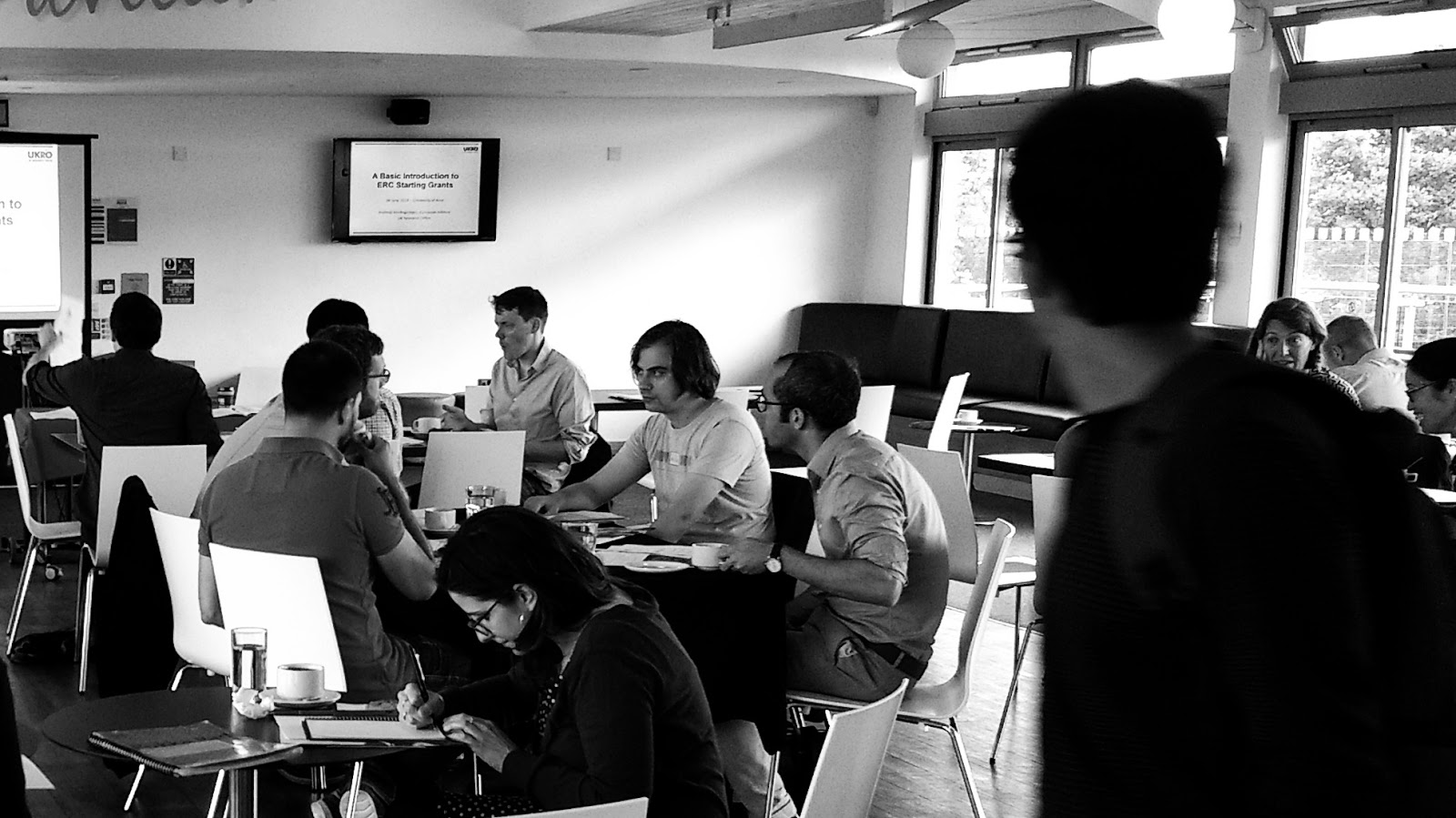 |
| The ERC Workshop last month |
The Project
Tracy is a paleoanthropologist, who looks at fossil remains to understand human evolution and development. Her €1.6m ERC-funded project, ‘GRASP’, examines two million year old hand bones to try and resolve two key questions in the field: did the earliest humans still use their hands to climb trees, and when did they start using tools.
The project uses innovative methods, including internal structural analysis using high-resolution microtomography (microCT).
Why Apply?
Tracy applied to the ERC in 2012, five years after getting her PhD. She was motivated to apply because her vision - and the research questions she was seeking to answer - required a large and complex project which was unlikely to be funded elsewhere.
Furthermore, the time was right for her. She had been at the Max Planck Institute, but neither her publication record nor her funding success were huge. However, she had had two high impact papers, including one as lead author that had made the cover of Science. In addition she was looking for a way to move back to the UK, as her partner was at UCL.
Writing the Application
‘Understanding the Participant Portal requires a degree in engineering’, Tracy joked, but her underlying point was well made: give yourself time to prepare and understand what’s required. But understanding the Portal was only the beginning, and Tracy mapped out a series of points to consider when preparing a bid.
Thursday, 10 November 2016
University Research Prizes: Call for Nominations

Prof Philippe De Wilde, the DVC Research & Innovation, has today issued the call for nominations for the 2017
University Research Prizes.
The Research Prizes were launched in Kent’s fiftieth
anniversary year (2015), and have already recognised a wide range of outstanding
research across the University. Details of the winners from 2015 and 2016 are available via
the links.
This year we are aligning the categories more closely to
those offered by the touchstone of excellent research in Europe, the EuropeanResearch Council (ERC).
Tuesday, 3 May 2016
How to Prepare a Successful ERC Application

Last Wednesday we hosted Maribel Glogowski, our UKRO
representative, who gave a thoughtful overview of the European Research
Council (ERC) and offered insights into how best to target the
funder. Dr Heather Ferguson, who recently won a
Starting Grant, joined her to offer an invaluable viewpoint from
someone who had been through the process.
Background
The ERC has been one of the great success stories of the
EC's Framework Programme. The prestigious, responsive mode fellowships were
clearly what the European research community wanted, and this was demonstrated
in the heavy oversubscription of the first call for Starting Grants in 2007,
when over 9,000 people applied for just 300 awards, giving a success rate of
just 3.4%.
Since then the situation has settled down, and now the
Starting Grant success rate is actually broadly in line with that of the ESRC
at 12%. In Horizon 2020, the ERC is part of the
'Excellent Science' pillar, which funds responsive mode research. Of the total
€24.2bn budget for the pillar, the ERC has almost half (€13.1bn). It provides
five types of grants:
●
Starting Grants:
up to €2m for 5 years for investigators 2-7 years from PhD
●
Consolidator
Grants: up to €2.75m for 5 years for investigators 7-14 years from PhD
●
Advanced Grants:
up to €3.5m for 5 years (no set career point restriction, but investigators
must be well established leaders in their fields)
●
Synergy Grants: up
to €15m for 2-4 investigators. The scheme is currently on hold.
●
Proof of Concept
Grants: for ERC award holders: up to €150k for 18 months.
Friday, 5 February 2016
Rampling and Wonnacott to Join ERC Scientific Council
Exciting news from the European Research Council. Not only have they secured the services of A list Hollywood legend Charlotte Rampling, but even more excitingly they've bagged former Bargain Hunt presenter and Strictly Come Dancing contestant, Tim Wonnacott. This is most reassuring: with a partnership like that, the future success of European research is in safe hands.
 |
| Rampling |
 |
| Wonnacott |
Any resemblance to Prof Barbara Romanowicz and Prof Sir Chris Clark is, of course, entirely coincidental.
 |
| Romanowicz |
 |
| Clark |
Thursday, 3 December 2015
Blofeld to Join ERC
Exciting news from the European Research Council. They've managed to secure the services of Tarantino favourite and Bond villain Christoph Waltz as a new Vice President alongside the two current incumbents.
This is very exciting news and will, I think, take the ERC in new and interesting directions. Any resemblance to Prof Klaus Bock of the Danish National Research Foundation is, of course, entirely coincidental.
This is very exciting news and will, I think, take the ERC in new and interesting directions. Any resemblance to Prof Klaus Bock of the Danish National Research Foundation is, of course, entirely coincidental.
 |
| Waltz |
 |
| Bock |
Tuesday, 18 August 2015
Going Mobile
 |
| 'The ERA? Isn't that like a European remake of Avatar?' |
It’s like discovering the secret patterns that explain the world, which goes back to my love of semiotics. So when a colleague presented me with slides from the European Research Council outlining ‘indicative statistics’ from its Starting Grants competition last year, I was in heaven.
What interested me most was not the success rates, which have never been great for the ERC (they average about 10-15 per cent, with a low point in the first round of 3.4 per cent); rather, it was the mobility.
What interested me most was not the success rates, which have never been great for the ERC (they average about 10-15 per cent, with a low point in the first round of 3.4 per cent); rather, it was the mobility.
Friday, 4 October 2013
'Funderland' (TM)
 |
| The ERC HQ: Heaven |
But before revealing my genius, let's take a step back and see how the idea came to be.There were two triggers, which both came from the recent trip:
- The Parliamentarium. This is the latest effort by the EU to convince all the naysayers that the Parliament is not just an expensive way to straighten our bananas, but has actually, y'know, stopped neighbours tearing chunks out of each other for the last sixty years. And you know what? It's actually very good. What could potentially have been a deathly tour into the minutiae of supranational legislative processes is actually presented in such a way that it inspires and cheers you. So what if they straighten a few bananas? They've found a way of getting people to talk to each other on equal terms. Museums tend to dwell on warfare and horror, on sacrifice, grimness and, well, pustules. But here was one that focused on quiet determination and success through bureaucracy. That's quite a feat for visitors' centre.
- The ERC Headquarters. Like the poisoned characters entering Heaven at the end of Monty Python's The Meaning of Life, we stared around at our surroundings in disbelief. Choirs of angels sang away in the distance. Lions lay down with lambs amongst the verdant greenery. Little elfin children skipped happily around around our feet. This was the entrance to the Covent Garden Building which houses the ERC. It was exciting enough to be at the epicentre of pure research in Europe, the beating heart of the beast that discards all other criterion in favour of Excellence. But for the reality to match my dream! It was almost too much.
Which is when I came up with my Great Idea. A visitors' centre - nay, a visitors' experience - based around research funding. If some American fella can build one around an oversized mouse, then surely, surely there's room for Funderland (TM)? Obviously, the details are still to be finalised, but here are some broadbrush ideas:
- 'Doom': This gives the public a sense of the grant writing process. It's a log flume ride. First, you go through a long dark tunnel that at times seems endless. You lose the will to live and are just praying for it to be over. However, before you know it the end is in sight and you start to panic. 'Wait!' you think, 'I'm not ready!' Whoosh you go, down the flume, and you feel momentarily exhilarated. This doesn't last. A big rubber hammer marked REJECTION hits you on the head and you enter the tunnel again.
- 'High n' Low': This is a giant, swooping rollercoaster that tries to reflect the typical reviews and grades for a funding proposal. Extreme highs! Unjust lows! Breathtakingly short! Interminably long! It's all here.
- 'Herding Cats': For animal lovers, FP7 coordinators and research administrators everywhere. You're given 13 cats, a rattle and a short piece of string. You have to try to herd all 13 cats through a complicated maze before the 'Submit' klaxon sounds.
- 'The Treadmill': There's a giant screen showing Isaac Newton, Charles Darwin and Albert Einstein doing a big, complicated experiment involving lots of expensive machines. They've just reached a point where they're about to solve a big, complicated question when - oh no! - the screen flickers and fades! It turns out that the screen is powered by sixteen treadmill 'grant' generators. Each has to be constantly kept going. If a visitors gets bored and steps off, someone else better step up! Ah the joys of the big project!
- 'Let's Interdisciplinate!': Visitors are given a random selection of five household objects. They have to work out how each can inform the others, and can benefit from the experience of the others.
Tuesday, 25 September 2012
ERC Stats

- Success rate by domain: Physical &Engineering Sciences 11.5%; Life Sciences: 12.0%; Social Sciences & Humanities: 9.7%
- Top 5 host countries: UK (131), Germany (78), France (73), the Netherlands (51) and Switzerland (33).
- Top 5 countries by PI nationality: Germany (92), UK (68), France (67), Italy (42) and the Netherlands (37)
- Top 5 (or 7) in UK: UCL (16); Cambridge (13); Oxford (12); KCL (8); Bristol, Edinburgh and Imperial (5 each)
- Average age of PI: 37 (the same as for the previous call)
- Percentage of female PIs: 24% (an increase from 21% last year)
A fuller breakdown of previous rounds of both the Starting Grants and Advanced Grants is available on the UKRO website (pdf). Start crunchin' those numbers...
Tuesday, 4 September 2012
Mists, Mellow Fruitfulness & ERC Deadlines

- Firstly, try and get a look at previously successful applications. This is true for any funder, of course, but perhaps more so for the EU, as people are often confused by the specific language and structure that is expected. Seeing how someone else has done it really helps.
- Secondly, and following on from this, make sure you 'give them what they want'. Look at the criteria, and make sure you are meeting them. These grants are about you and your project: be clear why you are the right person with an exciting, ground breaking project at the 'frontier' of knowledge.
- In turn, leading on from this, the ERC are looking for something different. Perhaps more than any other funder, this is the chance to take risks, to do something challenging. So use your imagination and think big - but couch it in a robust managerial framework that will reassure those of a nervous disposition.
- Get feedback. Lots of feedback. Here at Kent we've got the Internal Peer Review system, so get in touch with us as early as possible. But get feedback elsewhere, too: your proposal needs to be easily understood and inspiring by people who might not know the field, and whose first language may not be English.
- Submit early and often. Each time you submit it overwrites your last version. Don't leave it until the last minute when there will be, inevitably, a software crash.
- If you're shortlisted for interview, prepare throughly. Set up a mock panel (we can help with this) and go through a dry run. Take on board the feedback. Go over to Brussels the day before the actual interview and scout out the terrain. You don't want to get lost and arrive breathless, confused and red faced, or get derailed by Eurostar holdups.
- At the interview, they will use reviewers' comments to question your proposal. You won't have seen these, but try and pre-empt them by thinking what elements of your project will be seized on.
- Finally, think of the poor panel. Not only will they have ploughed through hundreds of applications, but they then have to sit for days in a small, stuffy room watching anxious academics perform. Engage them, and be enthusiastic and confident.
Thanks to Jo Frost at UKRO for running these events, and to Dr Lawrence Moon of KCL for sharing his experiences of applying to the ERC.
The Consolidator Grants came later, on 21 Feb, so annoyingly don't fit neatly into my Keatsian reference. But we never let the truth get in the way of a glib opening sentence here at Fundermentals Towers.
Monday, 30 April 2012
For Those About to Fail, We Salute You!

Although the ERC states that there will be a 'two-step peer review evaluation', the process will be more complicated than that. Here it is, step by step.
- Pre-selection. The chairs of the five peer review panels will cull the number of proposals to a more manageable number. The Guide suggests '7 times the indicative budget'. Assuming that the majority of applicants have put in the maximum allowable (€15m - and, if you're going to go for it, you may as well go for it), that means that this will cut out 90% of the applications. That's quite a cut.
- Panel. With what's left (c70-105 applications) the panel members will review them and gather to discuss them. They will whittle the applications down to '2.5 times the indicative call budget'. So that's another two thirds gone.
- New Panel. The original panel will now be exhausted, and will be discarded like empty husks. A new set of panellists will be selected. They will convene and cut the applications to '2 times the indicative budget' - i.e. 20-30 applications.
- Interview. Anyone left standing will be invited to interview, and there might be site visits as well.
Blimey. The Apprentice and The X Factor have nothing on this. Perhaps the ERC can generate a little extra income by selling the television rights? And introduce a fifth round that's something like The Hunger Games? I can see it now, with each candidate being paraded around Brussels in chariots prior to the final round.
Better still, perhaps Joachim Phoenix can play the panel chair, and Russell 'Group' Crowe a jobbing prof going for the Synergy grant that will release him from the treadmill of the application process.
If there are any Hollywood producers reading this, give me a call. I tell you, there are plenty more ideas where that came from.
Monday, 16 April 2012
Events of May
 It's like 1968 all over again. Sort of. Well, a lot of the events we've got planned may well mark 'the beginning of a prolonged struggle'. But be brave! Come along to one of the many events we've got planned, and we'll help you in the (funding) struggle. All are free, there are refreshments, and all staff are
welcome, but do let me know if you would like to attend any or all of them
so that I can get an idea of numbers.
It's like 1968 all over again. Sort of. Well, a lot of the events we've got planned may well mark 'the beginning of a prolonged struggle'. But be brave! Come along to one of the many events we've got planned, and we'll help you in the (funding) struggle. All are free, there are refreshments, and all staff are
welcome, but do let me know if you would like to attend any or all of them
so that I can get an idea of numbers.4 May: UKRO VISIT
- European Research Council Starting Grants (Keynes LT3, 12:30 -2pm) The next round of European Research Council Starting Grants is due to open in July, with deadlines early in the new year. These grants are very generous, offering those with 2-12 years postdoc experience up to €1.5m for 5 years. Competition is fierce, but success rates are on a par with those for Research Councils. Jo Frost, our Brussels’ UK Research Office (UKRO) rep, will provide an insight into these grants, and Funding Officers will be on hand to offer practical advice about
- Marie Curie Fellowships (Keynes LT3, 2pm – 3:30pm) Jo Frost will follow up her ERC talk by providing more information on the Marie Curie Fellowships. These are intended to encourage mobility for researchers within Europe. They can be on an individual basis, or as a network. The MC schemes are popular, and they have recently been revised by the EC. Jo will tell us more about these changes, and what the Commission has planned for the next Framework Programme.
9 May: EUROPE DAY
- PVC LUNCHTIME SEMINAR: ‘Europeanisation’ (Peter Brown Room, Darwin, 12:30-2pm) To mark Europe Day a special PVC’s Lunchtime Seminar will look at ‘Europeanisation.’ The Seminars offer a chance to find out about what research is happening across the University, and to meet others outside your School. The speakers are:
Simone
Glanert (Law): ‘How
‘Common' Is a Common Law Without a Common Language and a Common
Discourse: (Uncommon) Thoughts on the European Union’.
Ben Hutchinson
(SECL): ‘International Challenges for National Archives’.
Roger
Vickerman (Economics): ‘Economic integration through regional and
transport policies in Europe’.
Paolo
Dardanelli (Politics & IR): ‘European integration, party strategies, and state restructuring’.
- GRANTS FACTORY: ‘Eurovision: the Pros and Cons of European Funding’ (Peter Brown Room, Darwin, 2pm-3:30pm) This is a rerun of last year’s sell-out seminar that offers a warts and all view of the European funding. The EC is notorious for the complexity of its applications, but unlike the UK funding for research is ringfenced and growing. Jenny Billings (CHSS) and Simon Thompson (Computing), both veterans of EU funding, offer their insights into the highs and lows of applying for, managing and reviewing European applications. Places are limited, so book early.
10 May: UNDERSTANDING & APPLYING TO THE NATIONAL INSTITUTE OF HEALTH (NIHR) (Senate Building, 10am-4:30pm) Government funding for health-related research is distributed by the MRC and the NIHR. The MRC deals with basic research, the NIHR with research that will affect the NHS, including social care and public health research. Last year it gave out £210.5m of research grants through a range of programmes. This event will be a chance to understand how these differ and fit together. The programme will include talks by members of NIHR, as well as those who have had NIHR funding, and have helped with applications in the past. The full programme can be seen on the blog, here.
30 May: GRANTS FACTORY:
Writing Better Bids (Venue TBC, 10am-12pm) This perennial
favourite runs three times a year, and provides those attending with an
overview of what makes a good application, and how to draft your application so
that it is clear, readable and convincing. David
Shemmings provides insights based on the ’Grants Factory’ method developed
by Prof Andrew Derrington (formerly Dean of Social Sciences, now PVC at Liverpool)
and Jacqueline Aldridge. These are always well attended; book now if
you’re planning to draft a proposal.
Tuesday, 13 March 2012
Impact's Winged Chariot
 The President of the ERC has rejected the impact agenda, reports the Times Higher. At a conference last week Helga Nowotny said that there was an 'inherent tension' between the blue skies research supported by the ERC, and the 'demands of policymakers for practical innovation.'
'It all looks so easy, so obvious', she suggested, as politicians scrabbled to harness scientific research to pull European economies out of recession. 'But frontier science does not work like this. We cannot programme scientific breakthroughs or order them from a menu...We can't foresee the consequences of what we discover.' Politicians needed to trust 'the cunning of reason' to find uses for apparently 'useless' knowledge.
She pledged to uphold the ERC's independence in the face of political demands. 'It is very obvious that if we were to step back from the principle of excellence by only a tiny bit, it would be the end of the ERC,' she said.
How refreshing. Now I'm not saying that impact is a useless cul de sac, or that it diverts academic time and energy from the task in hand. However, I do think that it is not appropriate for all research and all projects, and we shouldn't have to try and shoehorn all research into impact's glass slipper.
Nowotny should be applauded for taking a stand and allowing the ERC's award holders the opportunity to breathe, to pursue research for research's sake, and not to have to look over their shoulders at impact's winged chariot hurrying near.
Tuesday, 31 January 2012
ERC Inundated by Applications for Synergy Grants
 Interesting statistics have emerged from the European Research Council regarding the number of applications to the pilot round of the Synergy grants scheme. You will, of course, remember that this was launched in July to encourage academics to group together to be more than the sum of their parts. Like the Beatles. I mean, aside from the Frog Chorus, has Paul McCartney ever done anything that touches his work with John Lennon?
 Anyway, as it was a pilot, they were only planning to fund 10 or so grants. However, they obviously touched a raw nerve of need amongst the European research community, because by close of play on 25 January they had received 710 applications. Now I'm no mathematician, but I make that to be a success rate of 1.41%. Eeek!
This brings back the heady days of the first round of the Starting Grants in 2007, when 9167 applicants applied for one of the 299 awards on offer. But even that offered a comparatively respectable 3.26% success rate - more than double the possible outcome for the Synergy Grants.
I'd love to know what's going through the mind of the ERC President Prof Helga Nowotny (whose surname, incidentally, looks a little like a mashup between the acronyms for the News of the World and Have I Got News for You). Panic? Fear? Or pleasure that, once again, the ERC has identified they type of funding that European researchers actually want: responsive mode, and generous.
I hope so. I hope that this experience does not deter the ERC from ever running the scheme again. Rather, I hope they bite the bullet and provide more funding for the scheme. There's obviously a pan-European appetite for such funding. Let's hope they're brave, recognise the demand, and provide the funding to at least push the success rate into double figures.
Friday, 16 September 2011
Notes from European Funding Clinic: ERC Applications

Yesterday's workshop on European Funding was a good chance for participants to 'test drive' their proposals. All those who attended were willing to both receive and give feedback on their proposed projects. Some of the general points that were raised included:
- Projects need to be both exciting and feasible, offering a step change in knowledge whilst also being grounded. The EC want to fund world-changing research, but also want to be reassured that you’ve thought through your project, that it’s achievable, and that you’re using an appropriate methodology with a realistic work plan.
- Therefore think about:
- Presenting an exciting question: the first step of the assessment process is for the panel to decide on who to shortlist for interview. The panel is very broad, and is unlikely to have experience of your area (see the full panel list, here (pdf)). Use the 5 page ‘extended synopsis of the scientific proposal’ (which is the only part of the proposal the panel will initially see) to ‘hook’ them in. Remember, the ERC is keen on ‘high risk/high gain’ research. Sell it to them: offer them a tantalising question, and follow it up by offering them a way to find the solution.
- Balancing them with a realistic work programme. Think about the structure, and break it up into achievable ‘work packages’. Think about the team: who do you need in order to complete these work packages? The ERC is offering generous funding, and it is more likely to fund a project that involves a team than one with a lone academic. However,everyone must be there for a reason: there can’t be any ‘passengers’ or‘baggage’. Their inclusion has to make sense. Don’t just include eminent or senior academics to show that you’re well connected, or to lend your project a glow of established credibility. The Starting Grants are for newer academics to become independent leaders, so don’t jump on the coat tails of others.
- Language: whilst the Work Programme may be ‘endlessly hyperbolic’ and ‘frantically bold’ (as one of the participants yesterday suggested), you need to be more low key and simple. Remember, the panellists (and later, external reviewers) will be from across Europe, and English is unlikely to be their first language. Keep it simple, and don’t ‘over conceptualise.’ Whilst you should make bold claims about your track record and the potential of your research, you should always ground these claims with evidence and demonstration.
- Experience: not everyone will have the perfect track record of publications and grants. However, capitalise on what you have achieved. Talk about how previous collaborations or small grants have demonstrated your ability to manage projects and lead groups, or how your previous work leads naturally on to your current proposal.
Saturday, 9 July 2011
ERC Launches New 'Synergy' Scheme
 At the UKRO Conference yesterday the EC’s Ben Turner gave some more detail of the European Research Council’s (ERC) new scheme, ‘Synergy’, which will be launched shortly with the new Work Programme in July. The Council already runs three schemes:
- Starting Grants: offering €2m over 5 years
- Advanced Grants: offering €3.5m over 5 years
- Proof of Concept: which provides existing award holders with funding to explore the commercial viability of the products of their research.
The Synergy Grant will be piloted in 2011-12. It will be allocated €150m so, whilst smaller than the Starting Grants (€730m) and Advanced Grants (€680m), it will be larger than FET. The intention of the new scheme is to provide funding for new collaborations. It will fund small groups of investigators (2-4) who can make the case that together they can achieve more than they can individually. They will fund 10-12 projects initially. The scheme is very open: the ERC has avoided being at all prescriptive. It’s been debating the new instrument for around two years, and intially toyed with the idea of restricting it to interdisciplinary projects, or cooperation with colleagues outside the EU. In the end it kept it simple. Almost nothing has been ruled out. There is an ‘expectation’ that it will be interdisciplinary, and that the investigators will be physically in the same place. But this is an expectation, not a requirement.
Friday, 17 June 2011
ERC Success Rates
 Interesting stats from UKRO on the ERC Starting (StG) and Advance (AdG) Grants. There's now been three complete calls for each scheme, and UKRO's statistics show how the success rate for both StG and AdG has risen:
- Starting Grants: 3.3% (2007-8) to 14.9 (2009-10)
- Advanced Grants: 12.7% (2007-08) to 13.2% (2009-10)
Interestingly, the success rates for Grants hosted at UK HEIs is higher than the European average for StG (17.3%), but only marginally so for AdG (13.6%).
Now compare these figures with those published by the ESRC in their Demand Management Consultation Paper on the recent success rates for all the UK Research Councils:
- AHRC: 16%
- ESRC: 17% (small and standard grants combined)
- MRC: 19%
- BBSRC: 22%
- NERC: 24%
- EPSRC: 30% (following the introduction of its blacklisting procedure)
- STFC: 53%
So the ERC success rates aren't a million miles away from the bottom three Research Councils - and the UK Starting Grants are actually the same or better than the AHRC and ESRC. No wonder the ESRC is making moves to introduce demand management measures, and the AHRC is following fast in its footsteps.
Thursday, 10 March 2011
ERC: Rumours of a New Collaborative Grant Scheme
 Hot on the heels of the news that the ERC would be rolling out a new 'Proof of Concept' scheme (which will probably be launched on 17 March), the word on the funding street is that the Council is planning a fourth scheme.
Provisionally called 'ERC Plus', my understanding is that it will provide funding for more collaboraitve research than is currently offered by the two current schemes. Thus, you will be expected to have between 2 - 4 investigators, all of whom should have a stellar track record. The intention is that ERC Plus projects will be 'more than the sum of their parts.' Together, the investigators will achieve more.
Initial signals are that it will have a 'pilot' round, offering €15om, with consortia able to apply for up to €15m for up to 6 years. So expect a rush of applications and resultant poor success rates. Keep an eye on the ERC website as details of the scheme are unveiled, probably when the next Work Programme is published.
Friday, 4 February 2011
New ERC 'Proof of Concept' Grant
 UKRO have found out more about the new ERC 'Proof of Concept' (PoC) scheme. As many of you will know, the ERC currently runs two schemes: the Starting Grant and the Advanced Grant. The PoC will be a third string to their bow. It was mooted in October, and is intended to provide translational funding to speed outcomes of research on to the market place. The PoC will only be available for those who already have an ERC award, although it doesn't have to be on exactly the same subject. UKRO gives this example: the PoC grant could be looking at commercialising discoveries made during an ERC grant such as a marker for cancer, even if the orginal grant was not about cancer, but the researchers happened to find a cancer marker when researching something else. The outcome of a PoC grant will be a package that can then be presented to venture capitalists.
UKRO believe that the first call could be launched on 15 March 2011, with closing dates on 15 June and 8 November 2011. The budget for the calls is expected to be €10m overall. This will be split between the two deadlines. However, if they're inundated at the first deadline they may cancel the November round. The intention is that applicants will be able to resubmit to future rounds.
From this pot roughly 66 projects may be funded (each project being worth up to €150k). There are currently about 1,600 ERC grant holders who may apply, but many of these grants are in the early stages, so it is hard to estimate how many proposals will be received.
UKRO believe the proposal format will be:
- a 7 page application long, with additional attachments such as 'letters of support', which will include the following sections:
- A short description of the idea and its relation to the previous ERC grant (although this is not specifically judged during peer review, it is still likely to be checked by the ERC Executive Agency staff);
- Outline an early-stage innovation strategy for the idea;
- Outline a reasonable and plausible plan of the activities; and
- Budget: list of requested resources and proper justification.
Do note, however, that this is early information, and details could well change, so treat with caution.
Subscribe to:
Posts (Atom)