Pages

Showing posts with label RCUK. Show all posts

Friday, 29 July 2016

Global Challenges Research Fund: A Primer

Introduction

The Global Challenges Research Fund (GCRF) was announced in last year’s spending review (December 2015), and came as something of a surprise to the sector. The previous spending review (2010) had protected the research budget from the worst ravages of austerity, but it was still a flat settlement, and funding was looking a little threadbare five years in.

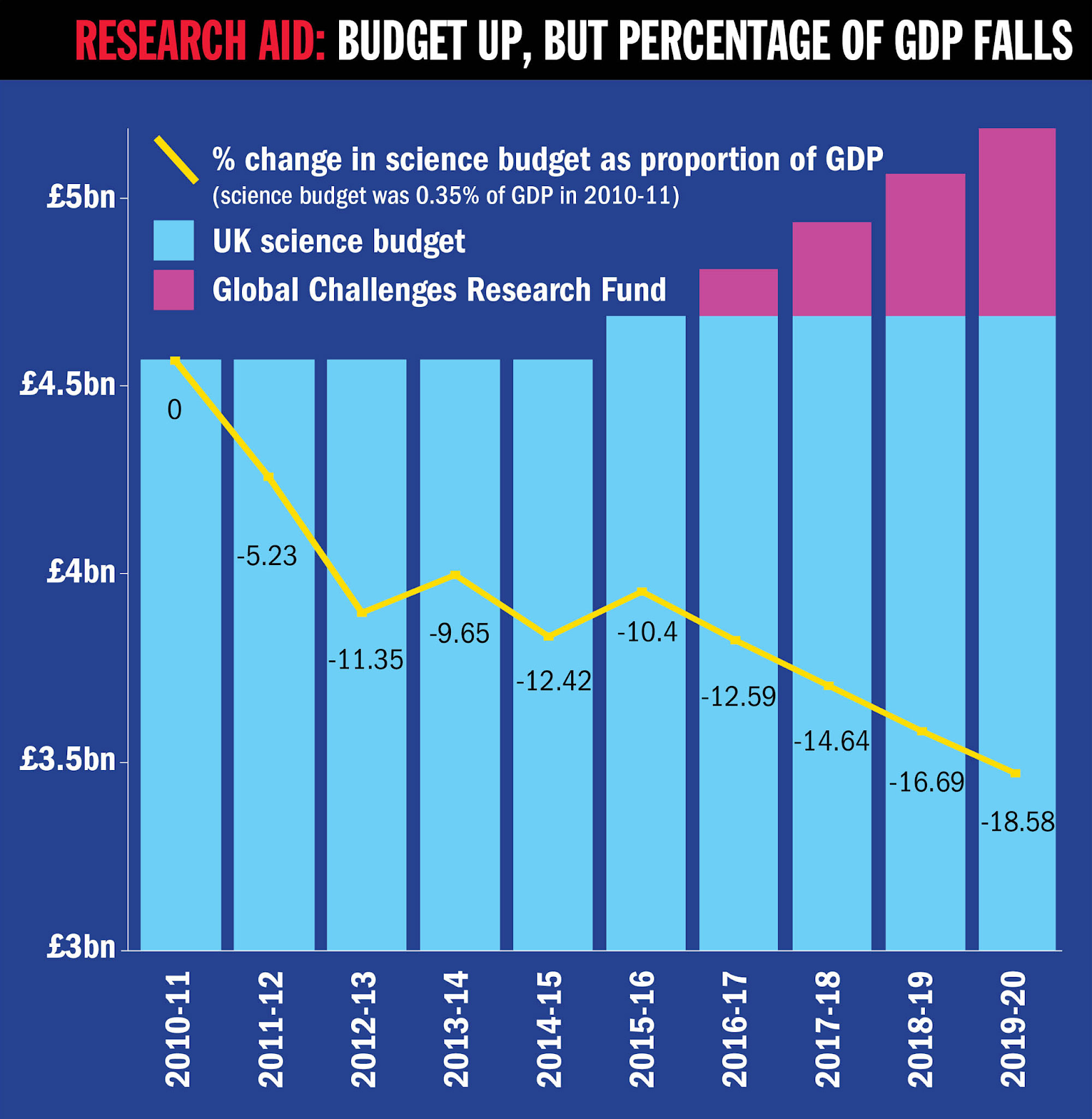
George Osborne, the Chancellor at the time, sought to remedy this somewhat, and announced that the research budget would rise from £4.7bn to £5.2bn by the end of the parliament (2020).

Source: THE
However, there was a catch. The extra £1.5bn would come from a different pot. It would not come from the budget of the Dept for Business, Innovation and Skills, but rather from International Development, and would aim ‘to develop new solutions to the complex multidimensional problems faced by developing countries.’ Note how the Science budget stagnates in the chart on the right, and GCRF rises.

Friday, 18 March 2016

Feeding Piranhas and Living to Tell the Tale

The Researchfish system is used to collect information on the outputs, outcomes and impacts that have arisen from Research Council-funded research. It tracks over 90,000 awards worth more than £40 Billion, and is used by over 63,000 researchers who have produced in excess of 1 million output reports to date. 

Submitting data on such a wealth of projects is no easy task, and universities across the UK have been making sure that their investigators provide these by the current deadline. At Kent, the job of ensuring its compliance fell to Sue Prout, Research Services Clerical Officer and PA to the Director of Research Services. Below she gives an insight into the challenges she faced in this unenviable task.

____________________________________________

Thursday, 27 August 2015

RCUK Grants to be Delayed 'Until the First of Never'

A successful Research Council applicant awaits his grant.
Following on the heels of the BBSRC's announcement that it would be delaying the start of responsive mode grants until after 1 January 2016, the umbrella organisation for the Research Councils, RCUK, has gone ones step further. In a press release written in crayon it stated that all seven of the Councils would delay the start of grants 'until the first of never'. 

'In order for the Research Councils to manage their budgets effectively,' ran the statement, '[and] allowing for additional investments whilst also maintaining their responsive mode commitments and success rate, we are intending to not actually hand out any money.'

Friday, 26 June 2015

RCUK Announces Major Breakthrough in 'Substance Free Strategy'

Groundbreaking 'tri-breast' logo.

RCUK, the umbrella organisation for the UK's Research Councils, announced a major breakthrough in substance-free strategic development today.

In a hastily convened press conference the Chair of RCUK, Prof Rick Rylance, explained the breakthrough.

'Researchers and policy makers have been working for decades, if not centuries, on this problem,' gushed Rylance. 'Is it possible to make policy announcements that are completely without any substance whatsoever? Last night our researchers identified that this was, indeed, the case.'

Wednesday, 21 January 2015

Nurse Review of RCUK: the Full Transcript

Sting. Possibly.
In December 2014 the Government published its new Science Strategy. It announced that it would launch a review of the Research Councils, led by the President of the Royal Society, Sir Paul Nurse.

Now read on.

Monday, 28 October 2013

Notes from 'OA: Understanding the New Environment' Event at Kent

Last week saw an international focus on Open Access (OA), and the University played a part by hosting an event to explore the brave new post-Finch world.

Dr Steven Hill
Dr Steven Hill, Head of Research Policy at HEFCE,  started the ball rolling. He traced current academic publishing practices back to 1665, when the first Secretary of the Royal Society, Henry Oldenburg, set up Philosophical Transactions. It was the world's first scientific journal, and set the template  for almost half a millennium of academic publishing.

450 years is pretty good going, but the old machinery is beginning to creak. 1.5m articles are published every year, roughly one every 20 minutes. We no longer have the ability to read - or even know about - all of these. OA offers us the tools to access and 'mine' this mountain. If we ignore it then we risk being suffocated in an academic landslide.

Hill went on to describe HEFCE's current consultation on incorporating OA in a post-2014 REF. The ultimate goal, said Hill, was to get 'maximum access to research outputs whilst sustaining the scholarly communication system.' To do so HEFCE believed that outputs submitted to the REF should be OA, but the devil was in the detail: what should be the criteria? What the definitions? What should be excluded? Hill outlined HEFCE's current thinking, and the issues it was grappling with.

Prof Rosemary Hunter
Prof Rosemary Hunter (KLS, Kent) took to the podium next with an inspiring tale of how she and her editorial team had used an online OA journal to overcome some of the problems inherent in traditional academic publishing. These included a lack of control over style, format and production, little or no remuneration, and the resulting journal being inaccessible to most of the world.

They decided, in 2006, to grasp the nettle and founded feminists@law to publish research on feminist legal studies. The cost of doing so was low: they were already providing their labour 'free' to the publisher, and the Open Journals System (OJS) was relatively low cost. Information Services provided some seedcorn funding for the initial venture, and the online journal has not looked back since. Feminists@law retains a robust peer review system, but is now accessed from a huge range of countries across the globe, allowing a wide diversity of voices to join the debate, to inform, to challenge and to discuss.

What surprised Hunter, when the Finch Report was published, was the apparent lack of attention given to this type of publishing, despite the potential benefits it offered. The debate was all about green versus gold, and there was little room for alternatives.

This issue came up time and again throughout the afternoon, with a number of speakers expressing their exasperation with  this polarity. Not only should the OA debate not be seen as just Green/Gold, but the assumption should not be made that Gold means expense: over two thirds of Gold OA journals are free.

Hunter finished by highlighting how light and flexible this new form of publishing was. It was light in terms of expense (a single Article Processing Charge (APC) could pay for the cost of a whole journal, using online OA), and flexible in terms of the type of media that could be accepted (it no longer had to be solely text-based); but it was not lightweight in terms of academic rigour or seriousness.

Hunter was followed by Dr Mari Williams, Deputy Director of the BBSRC and a member of the RCUK Research Outputs Network. She was inspired by Hunter's talk, and I got the sense that she had been at times frustrated by the pace of change elsewhere in the sector. RCUK had been having 'robust discussions' with publishers. Perhaps inevitably some were seen to be dragging their feet over OA, or rather were making the most of being able to generate income from both charging subscriptions and APCs, whilst also relying on 'free' academic labour.

Nevertheless, change was in the air, and RCUK had made considerable progress on the back of Finch since the policy had come into force in April. The landscape was moving quickly, she admitted, but 'not always in the direction we would have hoped for.' RCUK were hoping for 100% OA compliance by 2018, with 75% of that being Gold.

You could almost hear the sharp intake of breath across the audience. Here's hoping.

Dr Caroline Edwards
After a brief break Dr Caroline Edwards took to the stage. Edwards is a lecturer at Birkbeck, and co-founder of the Open Library of Humanities (OLH). This project aimed to build a 'mega journal' for the humanities, in the style of the Public Library of Science (PLoS), as well as piloting a scheme for OA monographs. She put up a slide that showed the huge rise in the cost of serial publishing compared to inflation: it looked out of kilter and unsustainable.

Those involved in OLH had taken heart from the 'hacker' culture in the sciences since the 1960s, the idea of 'gifting' knowledge for the advancement of the sector, and peers sharing and commenting on each others work.  Edwards had also set up Alluvium, a journal that allowed for the sharing of articles prior to publication, along the lines of arXiv, developed by physicists Paul Ginsparg as a way of getting feedback quickly from peers on 'pre-print' articles.

Kevin Ashley
At first Edwards' successor at the podium, Kevin Ashley, appeared to have the toughest call of the day: explaining and making the case for research data management. But he was an engaging speaker, and made a very convincing case: open sharing of data prevents both deliberate and accidental mistakes by allowing experiments to be reproduced, or sources to be investigated.

 However, this is not without its challenges: many researchers and academics are reluctant to release what they had spent years collecting. Moreover, even if they are willing (or forced) to share, how can all this data be archived and curated? The Digital Curation Centre, of which Ashley is the Director, is helping with this, but the task is not to be underestimated.

After the aspirational and inspirational, Dr Michael Jubb, Excecutive Director of the Research Information Network, gave some perspective on actual progress towards OA. After 20 years of OA, why have we not got further? Whilst a passionate believer in the cause, he recognised many of the issues which needed to be addressed. Many - on both sides - had very entrenched views, and there needed to be more compromise along the road. Perhaps more importantly, the UK is a minor but important player in the research world: 94% of articles have no UK investigator. The UK cannot implement OA alone.

The second Finch Report was due to be published imminently, and would assess developments since July 2012. Certain of these had the potential to completely change the landscape. For instance, some publishers were giving public libraries 'walk in' access to all of their titles. This could have the effect of giving public libraries access to a better range of cutting edge research than those of universities. What was really needed was coordination: funders, researchers, universities, publishers and learned societies needed to work together if the vision was to have any chance of being realised.

The University's VC, Prof Dame Julia Goodfellow, drew the event to a close by pulling together the strands that had been explored throughout the day. Issues of Gold or Green (or Hunter's 'inbetween'), of coordination, of 'double dipping' by publishers: much needed to be resolved, but OA had the potential to change how research was accessed and knowledge advanced. After 450 years, it's about time.
Thursday, 15 August 2013

RCUK Scrabble

It's holiday season, even for the good folks at Death Star Avenue. Now read on.

A holiday cottage on the west coast of Wales. Rain is lashing against the windows, and the casements are rattling. It's August. A group of RCUK apparatchiks are huddled around a game of Scrabble. It's clear they're playing an unusual variant of this family favourite in which only acronyms can be used.

Monday, 22 July 2013

Grands Projets: J'accuse

A previously funded large project.
The Times Higher last month published an article by Prof Bill Amos of Cambridge, who questioned the wisdom of funders moving increasingly to backing big projects, 'taking ever-larger bites from a modest and diminishing funding pot.' By doing so, Amos concluded, the funder 'starves the wider scientific community. Consequently, the next generation of scientists is already leaving, and many undergraduates I have spoken to feel that their chances of getting one of the handful of studentships on offer these days are too low to be worth the effort.'

Amos articulated what many of us have been feeling for some time. In recent years there has been an inexorable move by the Research Councils and the Wellcome Trust to concentrate funding on longer, larger grants. The logic is impeccable:  in order to answer the big questions that will make a big difference to society, we need big teams of big hitters doing big science. Or big social science. Or big humanities. Moreover, big projects don't require proportionately more administration, and by cutting back on all those pesky small grants, funders will be saving a lot of time and money in selecting and monitoring the things.

What has particularly rankled in this is a sense that the funders are shooting themselves in the foot. I always believed that the funders got many, many more bangs for their bucks by funding small grants. Principal investigators tended to makes sure that every pound, every penny counted. Better still, these small grants offered early career researchers a first step on the ladder of research funding. Sure, some funders do offer dedicated routes for ECRs, but they still tend to be be substantial, and the success rate as a result is negligible. Small grants with a high success rate allowed funders to light the blue touch paper and watch as the subsequent careers fizzed and whirred, glittering in a thousand different directions. To many, this initial light has been extinguished.

However, up until now this view was, for me, nothing more than a hunch. This changed last week when I stumbled across 'Big Science vs Little Science: How Scientific Impact Scales with Funding' via Twitter (thank you, Open Access).  Its authors, Fortin and Currie, looked at whether it was 'more effective to give large grants to a few elite researchers, or small grants to many researchers.'

Focusing on the Natural Sciences and Engineering Research Council of Canada and the National Science Foundation of America, Fortin and Currie start by asking what the goal of the funder is. Is it to maximise major discoveries (sometimes criticised as 'photo opportunity science'), or to maximise the 'summed impact' of the community. The authors looked at four measures of 'impact': total number of papers published, number of citations, number of citations for the most highly cited paper, and the number of very highly cited papers.

Interestingly, they found either no correlation or even an inverse correlation between size of grant and impact:  'impact is a decelerating function of grant size'. They continue: 'our results are inconsistent with the hypothesis that concentrating research funds on 'elite' researchers in the name of 'excellence' increases total impact of the scientific community. Quite the opposite: impact per dollar remains constant or decreases with grant size. Highly cited studies are no more likely to result from large grants than from spreading the same funds among multiple researchers.'

Furthermore, 'if maximising the total impact of the entire pool of grantees is the goal, then the 'few big' strategy would be less effective than the 'many small' strategy...funding more scientists increases the diversity of fields of research, and the range of opportunities available to students.'

The time has come to reconsider this passion for large 'ribbon cutting' projects. Whilst funding many small projects might mean that you can't blow your trumpet about unpicking the human genome, it will have a huge effect on a wide, diverse range of research and careers, which might actually have a more positive effect on the health of your discipline - and consequently your profile as a funder - in the long run. Funders, think again.

Monday, 15 April 2013

Is There Something Missing from ROS?

'We've got a record of  the number of bodies.
Who cares about the original bodies?'
As many of you will be aware, the Research Councils (RUCK) introduced the 'Research Outcomes System' (or ROS)  to monitor the outputs of their funded projects. The new system was launched on 24 Nov 2011, and took the place of Annual Reports and End of Award Reports, simplifying the wordy demands of its predecessors so that investigators need only note what publications (and other outputs) have resulted from a grant.

On many levels this makes sense, and RCUK aren't shy of crowing about the benefits:

  • It saves time. RCUK suggest this could be as much as 80% compared with the previous system.
  • It can be used at any time during or after the grant.
  • Multiple users can view the reports. 

And so on. All very good. But what struck me the other day is that the new system seems to miss out a crucial element of the End of Award Reports: monitoring and assessment. Whilst RCUK annual monitors compliance with ROS, there doesn't appear to be anyone checking the quality of the outputs or the success of the project measured against it's original aims and objectives.

Or am I missing something?

This seems to be a considerable oversight. When I worked at the AHRC, getting academic reviewers to assess the success of the project was a laborious but crucial element of the grant cycle. If a project was deemed to have failed to produce the intended goods, or had veered too widely from the original path, it could be labelled as 'unsatisfactory', and would have a limited time to come good. If it still didn't, the investigators would be barred from applying again to the Council.

Equally important, if the project had been seen to succeed beyond anyone's wildest dreams, it could be labelled as 'outstanding', and the investigators could bask in the glow of approbation.

Okay, so the old system may have smacked of the schoolroom, but I think it is important that investigators are held to account - for better or worse. The new system just seems to be a bit, well, quantitative.  As long as you give them a title or two, it doesn't really matter beyond that. The spaces are filled, the box is ticked, the numbers are counted.

As I say, I could be wide of the mark on this, and I'd welcome any thoughts from those in Death Star House as to the level of assessment that goes on post-project.

Tuesday, 9 April 2013

Bear Sh*ts in Woods Shock!

Pope: Catholic, apparently.
Well, you may have noticed that things have been somewhat quiet over at Fundermentals Towers. Yes, I've been away, furiously eating Easter eggs and huddling by an electric fire to keep warm.

I returned this week and found a great story to kick start a new season of blogging. On 5 April Research Fortnight reported that BIS had published a report that concluded that 'the richest universities take the lion's share under dual support'.

This must rank, for news worthiness, along side the recent discovery of the Pope's Catholicism. Yes, the biggest, most research intensive universities really do get most of the government's research funding. What are they going to discover next? That knowing more about stuff makes you cleverer? That drinking coffee makes you jittery? That dogs bark and cats miaow? That the 1994 Group lacks direction?

I guess what does make it interesting is the scale of concentration, and what that bodes for the future. The top 10% of universities (in terms of income) get 64% of the Research Councils' funding. The second 10% get 20%, the next 10%, the next 4%, until you get to the final 40% of universities which get nothing. Interestingly, this distribution has altered little over the last decade, which calls into question the belief that RCUK are moving to concentrate their funding on the big hitters.

So I shouldn't be so scathing. There's gold in there, but you just have to dig for it.

Monday, 25 March 2013

SSC Close the Circle

Shelby SuperCars Inc. Share an acronym
with the Shared Services Centre.
Oh! The glamour!

There's good news from the Shared Services Centre this week. And it's not often I get to write that sentence.

One of the long standing gripes for us research managers and administrators is that, whilst we're integral to the submission process for all Research Council applications, we don't directly get to hear the outcome of them unless they're successful. Whilst it's always nice to get good news, we would welcome bad news as well.

Why? Well, for one thing, it would let us tidy up our records. You know how anal us bureaucrats are. But, more importantly, it would help us to help the academics. When they get the dismissive one liner from the SSC, the chances are that they'll be a sobbing wreck on their office floor. If we had the nod from the SSC we could get in touch with them to talk about other alternatives. Or at least rail at the unfairness of it all with the applicant. We could share their pain.

So it was great to get the SSC email update this week and read the following: 'the Research Councils have agreed to provide feedback to Research Organisation administration offices on the outcome of proposals.'

Fabulous! But not only that, it sounds like the info they intend to provide will be more thoughtful than just a yes/no outcome. 'This will provide information on the relative ranking or scoring of proposals, as well as written feedback on the decision.'

Great news, then. They don't say when this system will be rolled out, but hats off to SSC for recognising a problem and moving to provide a solution.

Wednesday, 13 March 2013

Writing a Response to EPSRC Reviews


Making a virtue of criticism
Last week we had an impromptu Grants Factory workshop, prompted by the visit of the EPSRC's Jane Nicholson the week before. Focussing on applying to EPSRC, Profs Simon Thompson (Computing) and Sarah Spurgeon (EDA) spoke about their experience of sitting on EPSRC panels, before running a 'mock panel' exercise in the second half of the event. It was a really useful event, and I thought it would be good to jot down some notes from it, particularly around the vexed question of responding to reviewers' comments, which is crucial in applying to any of the Research Councils. So, if you have recently received your comments and are mulling over your response, some top tips:

  • The panel aren’t re-reviewing the application. They are instead moderating the reviews and ranking the applications accordingly. Thus, the PI response is critical, as it’s your only chance to answer any concerns or criticisms. Whilst it’s not mandatory, you should always provide a response. As Prof Sarah Spurgeon said at the event, ‘writing a good response does make a competitive difference’.
  •  Some of the reviewers’ comments can be hurtful. You’ve invested time in the application, and they can be dismissive or even wrong-headed. Don’t respond in haste. Take time to provide a measured, considered response. Don’t dismiss any comment that is ‘obviously’ wrong: you can make it clear that you disagree without using emotive language. For instance, suggest that you want to ‘clarify’ a point.
  •  Go through the reviewers and pick out every comment that needs a response. List them, and answer them in order.
  • Give evidence to rebut the criticisms. Once again, don’t be hasty and impassioned. This is the time to be clear and analytical. Give the panellists just the information they need, the information necessary to ‘empower’ them;  it’s not the time to be quoting complicated mathematical formulae – unless absolutely necessary.
  • Some responses may not be given to the panel before the meeting, but tabled on the day. The panellists have to read them quickly, so make it easy for them: plain language, clear formatting, bullet points. Don’t be ‘clever’ with unusual fonts, minimal margins or complicated figures.
  •  Don’t clutter the response by thanking the reviewers, or take too long highlighting the positive points. The panel will have already seen both the application and the reviews, and will already have a view.
  • Don’t feel you have to write to the limit. To quote Prof Spurgeon again: ‘a short response is more powerful.’
  •  Finally, if the reviewers have suggested a good idea, there’s no harm in welcoming it and agreeing with them – as long as it doesn’t contradict the main thrust of your proposal.

Tuesday, 20 November 2012

STFC: 'Too Narrow a Focus'

An advisory panel has today criticised the STFC for having 'too narrow a focus', Research Fortnight reports.

'For far too long STFC has thrown money at projects within its remit,' complained the 900 page report from the panel. 'Does it not realise that it should be launching expensive, half-baked interdisciplinary programmes?

'It's time it took advantage of RCUK's Priority Generator. Big Science needs this kind of cutting edge, outside-the-envelope thinking. Why fund astronomy and particle physics when you could be creating exciting, dynamic new research in 'Syntax beyond Food', or 'Enlightenment towards Remembrance'?'

No one from STFC was available for comment.

Monday, 19 November 2012

Stats, Black Eyes and Feathers in Caps

'No sir, a reduction in applications is a definite Feather in
your Cap'
As any research administrator worth their salt will know, The Times Higher published the annual stats for RCUK awards last week. In universities across the land there's fevered analysis, trying to work out (like Colonel Cathcart) whether they represent a Black Eye or a Feather in the Cap - or both, simultaneously.

After all the recent mission group shenanigans, I thought it would be interesting to see how the internecine factions within the Russell Group and 94 Group are performing. For this exercise, I've averaged out the figures for the following four groups:

  • RG Old: i.e. the original Russell Group, namely Birmingham, Bristol, Cambridge, Cardiff, Edinburgh, Glasgow, Imperial, KCL, Leeds, Liverpool, LSE, Manchester, Newcastle, Nottingham, Oxford, QUB, Sheffield, Southampton, UCL, Warwick
  • RG New: i.e. those that jumped ship from 94 Group and joined the RG in the summer, namely York, Durham, Exeter, QMUL 
  • 94 Former: i.e. those that jumped ship from 94 Group but are currently unaligned, Bath, St Andrews, Surrey 
  • 94 Current: i.e. Birkbeck, UEA, Essex, Goldsmiths, IoE, RHUL, Lancaster, Loughborough, Reading, SOAS, Sussex.

So, first, let's look at overall award value:


No surprise there: the old, 'big science' universities are getting the lion's share of the funding. What is interesting though, is that those universities that recently left the 94 Group to wander in the wilderness are actually generating more RCUK income than those that were invited into the hallowed portals of the RG earlier in the year.

Next application number:


Once again, no surprise: application numbers are down across the board. This is probably largely due to the Research Councils demanding demand management. They want less applications so their success rates don't look quite so pitiful. Interesting, again, the recent departees are putting in more than the newly anointed RGers. Some would say that the newly anointed are showing their quality: less is more. Others might say they are lazy laggards. I couldn't possibly comment.

Next, award number:


Once again, the Russell Group reign supreme, getting almost double the number of awards as their new intake. There had better be some sock pulling amongst those whipper-snappers. Moreover, RG are getting, on average, four times as many as the remaining 94 Group.

Finally, success rate:


A tight cluster here, around the late twenties/early thirties, but interestingly the wandering homeless outdo the folk on the hill (both old and new money).

So what to make of all this? I'll leave that to my fellow research administrators to decide on black eyes/feathers in their caps, and ultimately stats can be twisted to mean whatever you want them to mean (a nice blog post on this from Cash4Questions, here), but I hope it provides a pause for thought and a rethink about how we see ourselves.

Wednesday, 10 October 2012

RCUK Decent Success Rate Shock!

'100% you say? Well I'm sure
I could make my Chaucer
project fit  'Environmental Change''
Now here's a good news story that the Research Councils have been remarkably slow to crow about: success rates for most are looking surprisingly healthy. Looking at the latest published stats (RCUK has gathered links to them all here, including a broken AHRC one. *sigh* Best go direct, here), they give a lie to the current feeling that RCUK success rates have fallen so low that you may as well buy a ticket to EuroMillions. The  success rates for the five councils that have produced them for 2011-12 range from 21-41%, and average a healthy 31%.

Of course, there are a number of factors which have buoyed the figures:

  • firstly, some Councils have either introduced, or are strongly encouraging, some form of demand management. This is almost certainly the reason for EPSRC's 41% success rate.
  • secondly, other success rates are skewed by 100% success rates for some managed programmes, such as the 6 out of 6 that the AHRC's Researching Environment Change Follow Up scheme garnered. This helped the AHRC achieve an eye popping 40% success rate last year.
  • finally, many have seen application numbers drop, not necessarily because of demand management, but perhaps because applicants have become demoralised by rejection, or their attention has been diverted elsewhere, such as on the REF, or teaching , or (perish the thought!) impact activities.

I've collated the figures I can find, and the full table of application numbers and success rates can be found (for Kent staff only, I'm afraid) on our SharePoint site.

Saturday, 9 June 2012

RCUK Publishes Impact Case Studies

Last week RCUK published impact case studies. The intention of this was, I think, twofold: to highlight to external bodies (such as the Treasury) that public money is being well spent, and to highlight to potential applicants examples of best practice. Having read them all now I feel that they might have succeed at the latter, but not necessarily the former. Which is a shame, as I do think that it's crucial to make the case for the importance of research to government and the wider world.

The case studies are split into four categories: ‘policy’,‘business’, ‘public engagement’ and ‘voluntary and charitable’. Some appear in more than one category. RCUK had a huge pool of projects to choose from for their fourteen examples. The Research Councils give out grants for some 2,500 projects each year.As such, you would expect them to be spectacular examples of their kind, but I wasn't convinced.

Unsurprisingly, the business-related ones have the clearest impact and it is easy to make the case with these: licensing agreements, patents, and new technology with applications that will benefit society. All good. Things become a bit less clear in the other three categories which, to my mind, are somewhat weaker. Or rather, I think it’s very difficult to make the case. Many talk about ‘stakeholder engagement’, which of course is good, and of feeding into the development of policies and working practices. Which is also good. Others talk about their tweets and blogs, their public lectures and even their jazz compositions. Okay, so I know it's very hard to try and quantify the effect that these activities have had, but I would have thought that RCUK might have been able to provide more hard evidence as to the effect their funded research is having on society.

Nevertheless, I think the positive that potential applicants should take from this is that expectations are low and broad. If you can demonstrate that you are able and willing to engage with end users, to talk to school children and put on public events, then you will easily have met the expectations of your future paymasters. And, you never know, with your conceptual art spin-offs and children’s books sub-projects, you could well be up there on the RCUK website in years to come.

Thursday, 26 April 2012

Beware the Poets

I'm worried about those clever people at Polaris House. Our great and glorious research leaders, those academic taste makers who hold UK funded research in the palms of their hands, seem to be entering the world of self parody.

A couple of weeks ago I devised the Research Council Priority Generator. This randomly mashed together abstract nouns to create strategic priorities that sounded edgy and thoughtful, but were ultimately empty and meaningless.

Whilst it highlighted how randomness could produce apparent profundity, I thought it was too exaggerated and  stupid to really bear any resemblance to reality. How wrong I was. Within hours of launching the Generator, the AHRC had produced its latest 'emerging theme': 'Care for the Future: Thinking Forward through the Past'.

Beautiful. I couldn't have invented a better nonsense programme myself. But, oh, it got better. The AHRC weaved together a fine piece of poetic prose to explain the rationale of the theme: it was, they gushed, 'an opportunity for researchers...to generate new novel understandings of the relationship between the past and the future, and the challenges and opportunities of the present through a temporally inflected lens'.

'New novel'? Really? 'A temporally inflected lens'? If I had a temporally inflected lens I'd be sure to take it down to Jessops to have it looked at.

But the muse is upon them, and they continue in a stream of consciousness that would make Molly Bloom blush:
'...these include questions around what is meaningful about continuity and change, and the role that narratives, experiences, visualisations, performances and stories have to play in these processes. Issues around understanding modes of cultural learning and intergenerational equity, as well as questions relating to authority, ownership and justice within and across time, may help inform understanding of current and future global challenges faced by society today. Technological development, alternative lifestyle movements, and the nature of ideological and philosophical, ethical and creative, historicised and imagined perspectives jostle for attention and require a diversity of approaches and disciplinary engagements for the theme to reach its full potential.'
It's like a postmodern disciplinary shopping list, complete with an unreliable narrator. It's all there, but it's up the reader to try and make sense of it.

However, the AHRC is not alone in bowing to the creative urge. Following swiftly on this is EPSRC's announcement that it will be running a 'creativity greenhouse'. They've already had us playing in 'sandpits', and the TSB is encouraging us to develop 'catapaults'. What analogy, metaphor or simile will they reach for next? The ESRC Trouser Press? The NERC Hostess Trolley? The BBSRC Kenwood Mixer? Now there's an idea for a new generator...

But should we welcome all this creativity? After all, other great leaders have succumbed to the inner poet. Barack Obama has written poetry, as has Jimmy Carter. But then, apparently, so has Stalin, Mao, Pol Pot, Ivan the Terrible and Goebbels.

Hmm. On second thoughts perhaps the Research Councils should stick to their day jobs before they take UK research any further into this weird parallel universe.

Thursday, 29 March 2012

Research Council Priority Generator

Ever wondered how the RCUK chiefs come up with the strategic priorities? Do they sometimes seem - well - slightly random?

Well Fundermentals has managed to get its hands on the software programme that they use to devise their clever, cross-cutting, interdisciplinary programmes. For the first time we, the people, can click RCUK's 'button of power' and create whole new areas of research endeavour.

Go to the 'Research Councils Priority Generator' to have a go.

Monday, 27 February 2012

The Difficulty with Interdisciplinarity

Tim Harford, the self-styled Undercover Economist, wrote an interesting piece on his blog about the need to break out of disciplinary silos. He quoted Andrew Exum, a senior fellow at the Center for a New American Security in Washington DC, talking about military intervention in Syria. 'Regional specialists rarely understand military capabilities and options well enough to make an argument for or against, and those who understand military capabilities and options rarely understand the regional dynamics well enough to make an argument for or against.'

This is a neat encapsulation of the argument for interdisciplinary working. A similar line of argument was followed by Prof Rick Rylance, CEO of the AHRC, when he visited the University a couple of weeks back. However, Rylance was frank in his acceptance of the problems that those working in the disciplinary borderlands face. He gave an example from his own work: he's an English scholar by trade, and has worked with a neuroscientist to analyse brain patterns when people read poetry. Interesting stuff, but they had problems getting it published: humanities journals that thought that it was too scientific, and science journals that thought it was a bit too 'kooky.'

I think this won't be solved until the silos that Harford talks about are permanently dismantled, and that's not going to happen any time soon. Part of the problem is the REF (it's becoming a bit of theme today, isn't it?) which reinforces a need to focus strictly on comparing yourself with others in a narrowly defined field. If and when the silos do tumble, there's still the problem of identifying early which areas should be collaborating with which other areas. Harford recognises that it's difficult to have in place the necessary links for problems that cannot be predicted, such as Syria or the Lehman Brothers. However, he seems to be suggesting that cross-silo communication will help to pre-empt this, but I'm not so sure. After all, there's a lot of silos out there, and how do you know you've got on the line to the right one?

Which brings me quite neatly on to the question of Research Council thematic priorities. The Research Councils, as you know, have fully embraced the interdisciplinary agenda. Barely a week goes by without another call for interdisciplinary research. One academic joked with me recently that he imagined a large machine in Death Star House which automatically produced random pairs of abstract nouns, linked by a conjunction, to create the latest priority. 'Health and Wellbeing', 'Culture and Society', 'Science and Justice' etc etc.

But in all seriousness, how are such interdisciplinary areas identified? And what happens to the collaborations that blossom under the RCUK interdisciplinary sun when the weather changes? I think, too, that there is a question of critical mass. Kent was founded on the principles of interdisciplinarity, deliberately avoiding a departmental structure so that cross-disciplinary dialogue would happen in colleges, along corridors where philosophers would be housed next to astrophysicists. However, it had to bow to the inevitable and put all the philosophers together and all the astrophysicists together in separate departments. There is something to be said in having people in the same or similar disciplines together to concentrate their resources, their knowledge, their brain power on solving the issues pertinent to them.

So where does that leave us? Interdisciplinarity is good, but I don't think it's something that can be forced. I'm a little sceptical about calls to encourage collaboration in specific areas. Instead, there should be a broader willingness to accept interdisciplinary work in the mainstream academy, and thus in highly rated journals. In fact, when you think about it, these two concepts may go hand in hand: once the funders stop pushing specific (political?) areas then the scepticism amongst academics might abate, and we might well be left with a more open acceptance of the concept of interdisciplinarity.

Monday, 13 February 2012

AHRC's Rick Rylance to Visit this Friday

Prof Rick Rylance (Chief Executive of the AHRC and Chair of RCUK Executive Group) will be visiting the University on Friday 17 February. Rick will be speaking to staff at an open meeting in the Darwin Conference Suite at 1.30 pm about the AHRC’s Delivery Plan and strategic direction.

There will be plenty of time for questions so if you have a question about plans for longer and larger grants, the new Fellowship schemes, demand management or the influence of government policy on the Council’s strategy, please come along and ask.

Please let my colleague Lynne Bennett know if you are planning to come along so that she can get an idea of numbers.