Pages

Showing posts with label Oxford. Show all posts

Friday, 16 March 2018

Questioning the Cartel

Hotel Russell: Post-1892 (image: Tony Hisgett CC BY 2.0)
Anyone whose children are applying to go to secondary school will have been handed glossy prospectuses, with staged photos and talk of inspiring teaching and excellent facilities. Ignore all that and head for the back, where there are data on the destination of the leavers, showing how many have gone on to tertiary education and, of those, how many went to Russell Group universities.

The term is casually used as a shorthand for excellence, a sort of kitemark. There is an unspoken understanding that, while all those going on to universities are to be celebrated, only those going to RG universities matter. And I think that’s dangerous for UK higher education as a whole.

Tuesday, 27 November 2012

'Excellentiam per cognitio, innovatione et interdiu TV'

The Dreaming Spires of Rochester
We were delighted to learn that Fundermental Towers has been selected as one of a tranche of 'new' universities announced by the government today. Institutions no longer have to have 4,000 students to be classified as a university. Instead, institutions need only have three part-time students in order to join the likes of Oxford and Cambridge in the upper echelons of knowledge providers. I am very pleased to announce, then, that the ancient seat of learning formerly known as 2 Acacia Avenue, Rochester, will become Fundermental Towers University.

Break open the Asti!

Whilst we do not, strictly, meet the minimum criteria for student numbers at the moment, we believe we can make a start with what we have. Our children are broadly defined as 'students', albeit school age, and both the dog and the cat have demonstrated some interest in learning, even if it is just in finding out when feeding time is.

Yes, these are exciting times for Fundermentals University. Once I've completed the latest Cosmo questionnaire, I will make a start on filling in our REF submission. I will then move on to establishing an overseas campus at our Eurocamp tent on the Costa Brava. Finally, I intend to finance my retirement extend the opportunity for learning by offering mail order degrees a distance learning programme.

I would like to extend an invitation to all Fundermental subscribers to join us at our leafy North Kentish campus where all our undergraduates, including Rover and Tibbles, live by our motto: Excellentiam per cognitio, innovatione et interdiu TV, or 'Excellence through Research, Innovation and Daytime TV.'

Wednesday, 21 November 2012

Oxford's Server Gets Reboot

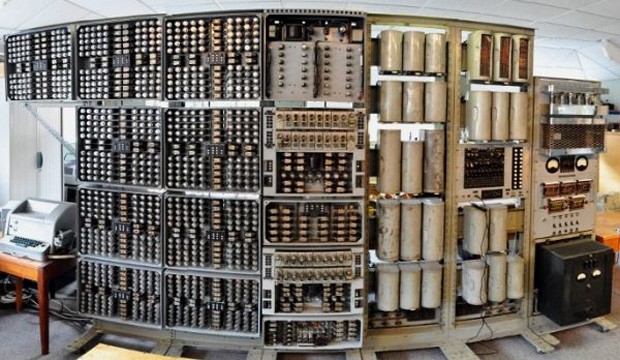
It was heartening to hear that the computer that powers the ancient academic powerhouse of Oxford was kicked back into life at The National Museum of Computing in Bletchley today.

'We've never had a problem before,' confided the Director of IT and Magical Things at St Heathen's College Oxford, Prof Sir Norman Dumblewick, 'although there was a scare in 1974 when there was a shortage of string and valves due to the three day week.'

'People are forever 'upgrading' and buying fancy new iPads and whatnot, but we've had the same server here since 1951 and it is still supporting the fellows' world class research.'

'It's a little known fact that we at St Heathen's were the first to develop the 'world wide web'' continued Dumblewick. 'However, we understand the 'world' to mean the 38 Oxford colleges. Which I think is fair.'

'Yes, the future of research in the UK is safe in our hands', concluded Dumblewick, as the machine behind him started to make an alarming crunching noise. Dumblewick turns and delivers a swift kick. 'That's what we call 'rebooting',' he wheezed, chortling and coughing in turn for some minutes.

Thursday, 1 November 2012

Bath to Join Million+ Shock

Coffee time in the Million+
Senior Common Room
Following its departure from the 94 Group, Bath has shocked the sector by applying to join Million+ rather than the Russell Group.
'Membership of the Russell Group does not reflect the type of university we are, nor sit well with the future direction of the University’s strategy,' said Bath's VC, Prof Glynis Breakwell. 'The Russell Group is perceived as too 'Old Skool', and we feel the future lies with Million+'.
However, it is still uncertain whether Million+ will accept Bath's membership application. 'To be honest, I'm not sure we want them,' said Million+ Chair, VC of the University of East London, and former Avengers star Prof Patrick McGhee. 'Current members will have to vote on whether we want to admit a pre-92 institution to be in our gang.'
Other universities have tried and failed to join Million+. It is understood that, when upstarts Exeter, York, Durham and QMUL joined the Russell Group in March this year Oxford, Cambridge and Imperial tried to jump ship and join the elitist Million+, but were refused.

Tuesday, 25 September 2012

ERC Stats

We all love a good stat or two, and UKRO have obliged by providing some for the last round of ERC Starting Grants. I tweeted these yesterday, but in case you missed them, here are headlines:

  • Success rate by domain: Physical &Engineering Sciences 11.5%; Life Sciences: 12.0%; Social Sciences & Humanities: 9.7%
  • Top 5 host countries: UK (131), Germany (78), France (73), the Netherlands (51) and Switzerland (33).
  • Top 5 countries by PI nationality: Germany (92), UK (68), France (67), Italy (42) and the Netherlands (37)
  • Top 5 (or 7) in UK: UCL (16); Cambridge (13); Oxford (12); KCL (8); Bristol, Edinburgh and Imperial (5 each) 
  • Average age of PI: 37 (the same as for the previous call) 
  • Percentage of female PIs: 24%  (an increase from 21% last year) 
A fuller breakdown of previous rounds of both the Starting Grants and Advanced Grants is available on the UKRO website (pdf). Start crunchin' those numbers...

Friday, 13 July 2012

O Tell Me the Truth about Concordats


It’s a little known fact that, shortly after graduating, WH Auden worked in Oxford University’s Research Office. Whilst he was there he had to deal with various strategic policies, concordats and memoranda of understanding. He became increasingly frustrated with these, and vented this irritation in an early draft of one of his most famous poems, ‘O Tell Me the Truth about Love’. In the week in which Universities UK announced its ‘Concordat to Support Research Integrity’, and LERU issued a paper on gender in universities, it’s worth reprinting this forgotten masterpiece.

O Tell Me the Truth about Concordats

Some say concordats show the way
They move the question on.
But others scoff and turn away
And say that they’re all wrong.
And when I asked the bureaucrat 
Who looked as if he knew, 

His boss got very cross indeed, 
And said it wouldn't do.

What are these words, these shiny words,
That trumpet and aspire?
That build imagined pleasure domes
With proselyte desire?
And when you try to pin them down
They flit like darkling bats
And float like smoke above the town
O tell me the truth about concordats.

At meetings they’re referred to
And duly noted down
But all around the table
There’s academic frowns.
They struggle with their purpose,
They struggle with their sense.
They try to take some action
For fear of seeming dense.

Do they shout like manifestos?
Or rattle like shopping lists?
Could one give a first-rate imitation
If one’s somewhat Brahms and Liszt?
Do they whisper in your ear,
Or demand: ‘do this, do that!’
Do they need your full attention?
O tell me the truth about concordats.

I tried to find the meaning
I searched the halls and quads.
And some who saw me whispered:
‘He’s a miserable sod’.
But still I found no answer
The emptiness remained.
These words so drained of meaning
A vacant picture frame.

Do they make a real difference?
Do they change the way we think?
Or are we better at the races,
Or fiddling with string?
Like shadow boxers sparring
Or like Schrodinger’s cat
They’re blithe and insubstantial
O tell me the truth about concordats.

As I’m sleeping in my bedsit
A nightmare tiptoes in:
A giant, laughing concordat
That affirms and agrees and spins.
It towers high above me -
But disappears, just like that -
Leaving no one any wiser
O tell me the truth about concordats.

Monday, 12 March 2012

Light up the Cigars, Boys

I was very excited to read today about the elevation of the Universities of York, Durham, Exeter and Queen Mary's to membership of the Russell Group. My excitement was tempered, however, by a concern that RG was beginning to lose its elitist edge. After all, with this move the 94 Group becomes more of a select group than the RG: 94 has a svelte membership of 15 against the morbidly obese RG 24. In fact, the Russell Group is now less selective than the University Alliance (23 members), and only slightly more selective than the Million+ group of post-92 universities (26 members).

It's ironic that, in the year it reaches the age of majority, RG should run to fat so quickly. RG is going to have to start thinking about how to slim down, to regain the trim figure it cut in its prime.

Might I suggest the Fundermental Diet? It comes highly recommended by snobbish institutions the world over, and is remarkably simple. All it needs is for a self-selecting group within its ranks - let's say, for the sake of argument, Oxford, Cambridge and Imperial - to break away and form a 'premier' body. Let's call it the 'Premiership' RG (TM).

This would make total sense. After all, we need to protect the elite from the influence of the riff raff and the hoi polloi. You know, those concretey, provincial johnny-come-latelys. These - sniff - Million Plusers.

But why stop there? There are always a few extra ounces, a few competitors, to shave off. Once the Premiership RG is up and running the case could, nay should, be made for distinguishing between the 'Ancient' Premiership (TM) of Oxford and Cambridge, and the 'Modern' Premiership (TM) of Imperial.

If this distinction isn't made, how will league tables, potential students and funders tell them apart? We need this distinction or all sorts of chaos will ensue. Institutions might be treated equally, with quality research being recognised wherever it is found - and then where would we be?

Yes, these distinctions, these groupings, are very, very important. Ultimately, however, there needs to be a Supreme Champion of Champions, a Summa Cum Laude University, by itself, for itself, standing proud, above the rabble, alone. A touchstone university, that would act as the university against which all universities should be measured. A Premiership RG of one.

But how can we select this RG Sine Pari? Of course, for this we should rely on the tried and tested methods of self-selecting groups the world over. Light up the cigars, boys, and let's fill this room with smoke.

Friday, 16 October 2009

RCUK Serendipity Award: an Unexpected Impact

The Times Higher RCUK-sponsored Serendipity Award was awarded this year to Mark Moloney, of St Peter’s College, Oxford. While researching how penicillin is made, he discovered that a similar process could be used to encourage dye migration in plastics.
Congratulations to Dr Moloney, but I wonder if his serendipitous discovery has been stymied by not setting out beforehand how he will exploit it in his 'Impact Plan'?

Thursday, 1 October 2009

Impact Seminar with Steven Hill (RCUK): 8 October

A final reminder about the Impact Seminar next Thursday. As you can see from many of the preceding posts, 'Impact' is a key issue in research funding at the moment, and this Seminar will be the chance to hear from two sides on this: Steven Hill (note his blog entry on 'Impact') is head of the Strategy Unit at RCUK, and has worked at both Defra and Oxford. He'll be presenting the 'official' RCUK viewpoint. Prof Peter Taylor-Gooby, Professor of Social Policy in SSPSSR, will be giving an academic's viewpoint. Their talks will be followed by a discussion chaired by Prof John Baldock, PVC for Research.
If you would like to come along and have not been in touch already, do drop me a line.