Pages

Showing posts with label UCL. Show all posts

Tuesday, 12 September 2017

Giving Voice to Researchers

Vitae Conference Pack: bewildering
I last went to a Vitae Conference in 2014. In the three short years that have followed the research landscape has shifted completely. Of course, we have had the EU Referendum with the jittery uncertainty that's resulted, but there's also been the REF2014 results, the first outcomes of H2020, the Higher Education White Paper, the Nurse Review, the Stern Review, and the first announcements about REF2021. In those 36 months the research ship of state has tilted and we're waiting to see where all deckchairs have ended up.

Although the plenary was somewhat muted - I got the feeling that there was a nervousness hanging over the panel, and no one wanting to show their full hand to anyone - #vitae17 has been a chance for all those who support researchers to take stock, to assess what's worked, and to think about how best to go forward.

Tuesday, 25 July 2017

Advice on Applying for an ERC Starting Grant

The ERC Workshop last month
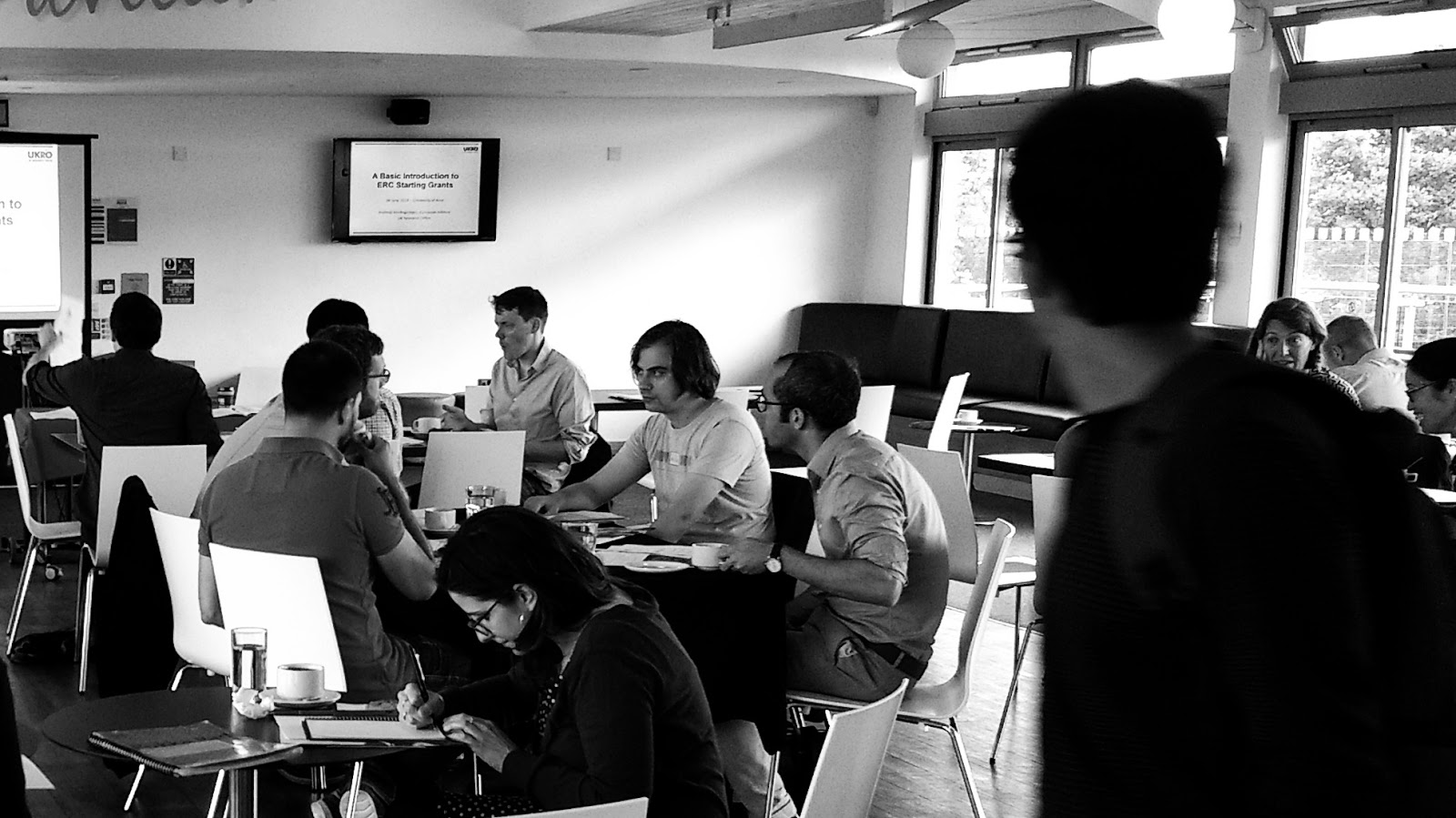
Last month we held a workshop on applying to the European Research Council. As well as getting an overview from UKRO, we heard from Dr Tracy Kivell, who won a Starting Grant in 2013, who talked about her experience of applying to the ERC.

The Project 

 Tracy is a paleoanthropologist, who looks at fossil remains to understand human evolution and development. Her €1.6m ERC-funded project, ‘GRASP’, examines two million year old hand bones to try and resolve two key questions in the field: did the earliest humans still use their hands to climb trees, and when did they start using tools.

The project uses innovative methods, including internal structural analysis using high-resolution microtomography (microCT).

Why Apply? 

Tracy applied to the ERC in 2012, five years after getting her PhD. She was motivated to apply because her vision - and the research questions she was seeking to answer - required a large and complex project which was unlikely to be funded elsewhere.

Furthermore, the time was right for her. She had been at the Max Planck Institute, but neither her publication record nor her funding success were huge. However, she had had two high impact papers, including one as lead author that had made the cover of Science. In addition she was looking for a way to move back to the UK, as her partner was at UCL.

 Writing the Application 

‘Understanding the Participant Portal requires a degree in engineering’, Tracy joked, but her underlying point was well made: give yourself time to prepare and understand what’s required. But understanding the Portal was only the beginning, and Tracy mapped out a series of points to consider when preparing a bid.

Monday, 15 July 2013

The Difficulty of Cross-ImeanInter-ImeanTransdisciplinarity

'Say, Prof: what's that word again?'
On Friday I went along to a symposium organised by SHARE that looked at the thorny issue of facilitating transdisciplinarity research. Despite the sweltering heat and the fabulous catering, both of which were very diverting, it was an interesting event, but perhaps not for the reasons that the organisers had originally intended.

The first reason was that the whole thing defied easy labelling. The first twenty minutes were spent on a 'taxonomy' of the label that should be used for work that transcends more than one discipline. In summary:
  • Interdisciplinarity: when the techniques from one discpline are used in another;
  • Multidisciplinarity: when many disciplines are working together on the same question;
  • Crossdisciplinarity: is a generic term which shouldn't be used any more. You have been warned;
  • Supradisciplinarity: when new approaches are used to inform a number of disciplines;
  • Transdsciplinarity: when the work moves beyond traditionally defined boundaries. 
There were a couple of other definitions, but by then I was having trouble keeping up and noting down the nuances that differentiated these. Others were having similar problems, so that, throughout the day, whenever anyone mentioned working across the disciplinary divide, it was mentioned as 'Cross-ImeanInter-ImeanTransdisciplinarity.' Which was quite a mouthful, and did have the effect of slowing discussion. 

The second, more substantive reason that the day was illuminating was that it became clearer and clearer, to me, that Cross-ImeanInter-ImeanTransdisciplinarity cannot be taught. You either get it or you don't. Those that do, like the first speaker, Dr James Steele (UCL), are slightly perplexed that anyone needs to even ask why they do it, or how.

Much of the questioning following his talk were along the lines of, 'but what skills are needed to do Cross-ImeanInter-ImeanTransdisciplinarity?' Steele would, say, 'well, there are elements of archaeology, and obviously you need medical scanning techniques...' The exasperated questioner would then interrupt: 'No, but what skills did you need to bring all these different disciplines together?' And on they went.

Because for some, it's just what they do. They recognise that to answer the questions that interest them, they need to bring together experts from a range of disciplines. If you artificially try to do this, to try and answer one of the weird and wonderful RCUK calls developed by their Priorities Generator, then you're on a hiding to nothing, and however hard you try, it's just not going to work.

So what's the role of us research development managers in this? The symposium made me recognise that our job is not to artificially jam people from diverse disciplines together in a room and say, 'you're not coming out until you've created something! And make sure it's expensive!' Instead, we need to make sure that the support that we provide and the environment in which the work, are conducive to Cross-ImeanInter-ImeanTransdisciplinary working.

Thus, we might help academics find out what else is going on across campus, or provide information on sources of funding, or make sure that they've thought about how to exploit their pathways to impact, but we can't tell them how, or with whom, they should be working. That is up to those who do this without thinking, those who are the real champions of Cross-ImeanInter-ImeanTransdisciplinarity.

Tuesday, 25 September 2012

ERC Stats

We all love a good stat or two, and UKRO have obliged by providing some for the last round of ERC Starting Grants. I tweeted these yesterday, but in case you missed them, here are headlines:

  • Success rate by domain: Physical &Engineering Sciences 11.5%; Life Sciences: 12.0%; Social Sciences & Humanities: 9.7%
  • Top 5 host countries: UK (131), Germany (78), France (73), the Netherlands (51) and Switzerland (33).
  • Top 5 countries by PI nationality: Germany (92), UK (68), France (67), Italy (42) and the Netherlands (37)
  • Top 5 (or 7) in UK: UCL (16); Cambridge (13); Oxford (12); KCL (8); Bristol, Edinburgh and Imperial (5 each) 
  • Average age of PI: 37 (the same as for the previous call) 
  • Percentage of female PIs: 24%  (an increase from 21% last year) 
A fuller breakdown of previous rounds of both the Starting Grants and Advanced Grants is available on the UKRO website (pdf). Start crunchin' those numbers...

Tuesday, 22 November 2011

Tales from Topographic Oceans

I don't know, you wait ages for a senior appointment at the Research Councils, and then two come along at the same time.

After all the excitement over the AHRC's New Director of Research, news has just come in of the appointment of the new head of the NERC. It took them nearly five months to find someone: that's almost as long as Mark Llewellyn's total academic career.

So who has NERC gone for? Prof Duncan Wingham is Professor of Climate Physics at UCL. The golden-locked prof is a specialist in measuring ice sheet movements. So whereas the AHRC has gone for youth and speed, the NERC seem to have taken a 'steady as she goes' approach. Prof Wingham has been at UCL since 1986, and was already Chair of NERC's Science and Innovation Strategy Board. So very much a known quantity. Oh, and he studies glaciers.

We wish him all the best. But now down to the serious business of trying to match him up to a look-a-like musician. We've got Derek Smalls in David Delpy, Donny Osmond in Mark Llewellyn, and even Andrew Lloyd-Webber in his predecessor, Alan Thorpe. Is there a touch of the keyboard virtuoso Rick Wakeman in Duncan Wingham?

Tuesday, 28 September 2010

'There Is No Definition of the Ideal University'

Interesting counterblast in the Guardian last week to the puffing and posing that goes with the announcement of the World University Rankings.
'Imagine a newspaper decided to create a table ranking the world's cities,' suggests Malcolm Grant of UCL. 'It would be a nonsensical exercise.' There's no such thing as an ideal university, he says, and trying to compare a university in one country with that in another is ridiculous. Even within countries, universities vary massively. For example, the research income for a science or medical university are going to be much greater than for one focused on the humanities or social sciences, but that doesn't mean that the research of one is 'better' than that of the other. Even using citations is dangerous: Grant points out the example of one of the recent sets of rankings that concluded that Egypt's Alexandria University trumped both Stanford and Harvard for their influential research measured by impact.
'Global rankings have afforded annual light entertainment, but they are now seriously overreaching themselves,' he concludes. 'They do a disservice if they influence student choice, or come to be treated as a performance measure by the leaders of hugely diverse institutions.'

Wednesday, 30 September 2009

Research Ethics Committees: Help or Hindrance?

UCL are holding a two day conference examining the work of university research ethics committees. It will take place on 12 and 13 November 2009.
While ethics committees are now a familiar feature of research institutions especially within the NHS, academic work on their role, remit and function is still in its infancy. The theme for the conference is how effective ethics committees are in reducing risks to subjects of research without over-burdening researchers with bureaucracy.
More details available here.